PUDU SH1: the compact scrubber-dryer that scrubs and dries in one go
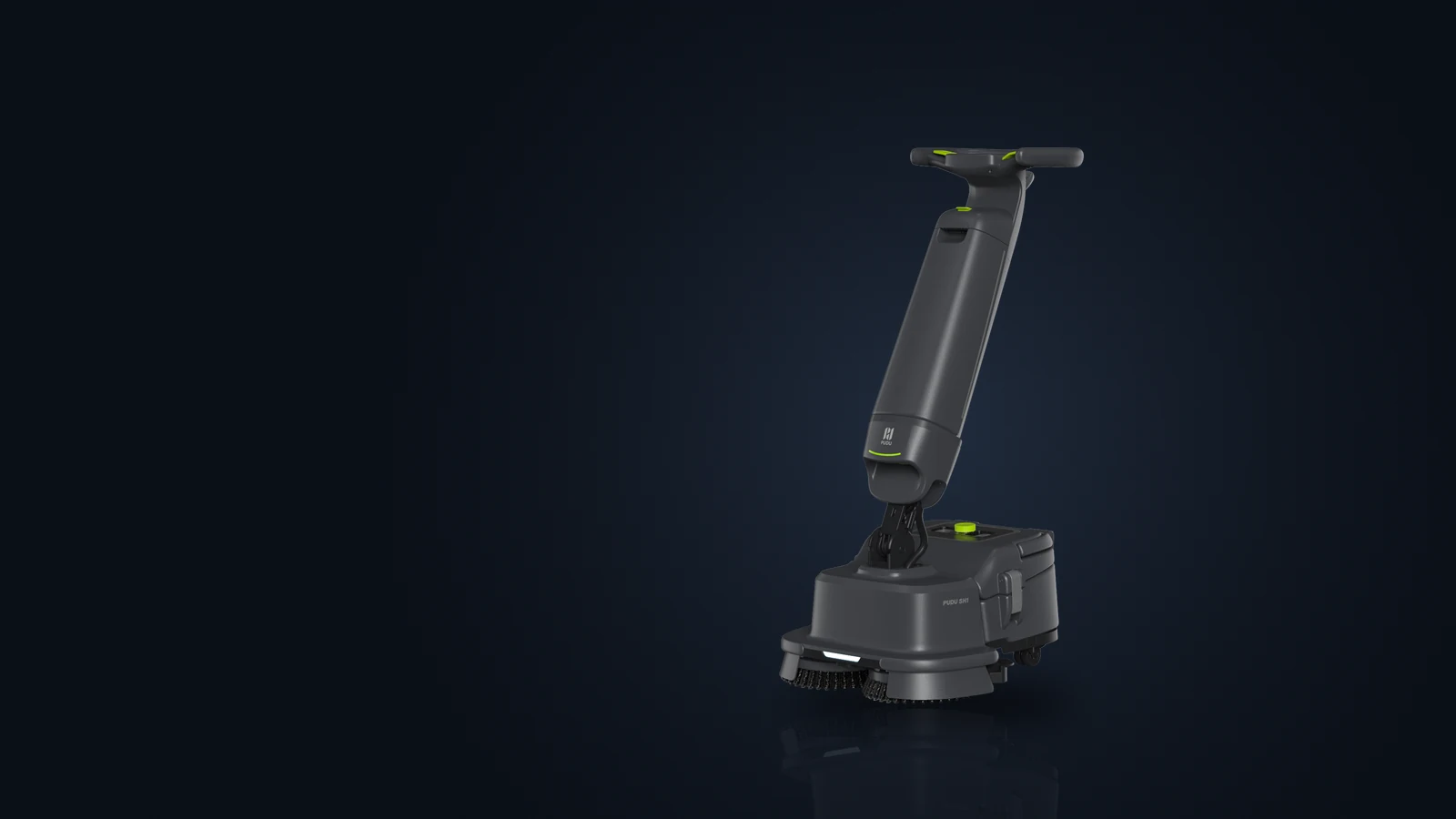
A cordless walk-behind scrubber-dryer guided by the operator: it scrubs, vacuums and dries in one pass, reaches under tables and cleans walls.
Distributed by Easy to Clean, an authorised PUDU distributor: free demonstration on your floors, all-inclusive rental or purchase with maintenance.
What it brings to your floors
Scrubs and dries in a single pass
Two disc brushes and a suction squeegee: the floor is clean and dry behind the operative, with no waiting time.
- Immediate drying
- Fewer slippery areas

A hand-guided machine
Driven forward by its brushes, it moves under the operative's hand, who guides it effortlessly wherever your team needs it.

Vertical surfaces and hard-to-reach areas
Dedicated attachments for shop windows, tiled walls, mirrors and areas that are difficult to access.
Dining room, under tables, walls: the SH1 at work
Manufacturer visuals, in the order of a day in a restaurant.

Sauce, grease, debris: clean and dry in one pass
Two disc brushes at 350 rpm and 20 kPa of suction: the operator cleans the dining room between two services, and the floor is dry behind them. On thick grease, soak mode lets the solution work before suction.
- Two disc brushes
- 20,000 Pa suction

The handle lies down to reach under tables
The handle tilts almost flat, down to 25° from the floor in the manufacturer visual, and the head reaches under tables and benches, where a conventional scrubber stops.
- Low head
- Less furniture to move

A handle that swivels 360°
A two-axis joint lets the handle swivel 360°: the operator gets around chair legs, corners and counters without manoeuvring. A lever on the handle locks or releases the position.
- 360° swivel
- 27 kg, self-propelled

Walls, shop windows and wall tiles
Dedicated accessories extend the machine to vertical surfaces: tiled walls, shop windows, mirrors.
- Dedicated accessories

Dirty water separated from air and debris
Recovered water is separated from air and solid residue before the tank, which protects the suction and makes emptying simpler.
- Air, liquid, solid separation
- 4 L tanks

Modes chosen on the screen
Eco, standard, high, soak, suction only: the operator matches water flow and power to the dirt. The screen also flags low water, a full dirty tank, a blocked duct and brush wear.
- Eco, standard, high, soak
- Water, tank and brush alerts

Floor, edges, under tables, vertical surfaces
The manufacturer visual sums up its uses on a single site: everyday floor, edges, low areas, table tops and vertical surfaces.
The sites where it fits
The sites where we deploy it, and what we look at during the demonstration.
Restaurants and quick service
Dining room, open kitchen, walkways: a scrub-and-dry between two services.
Shops and boutiques
Mid-sized sales floors, entrances, fitting rooms: the machine comes out of the store room in seconds.
Hotels
Breakfast rooms, lobbies, floor service rooms.
Healthcare and gyms
Corridors, changing rooms, washrooms: an immediately dry floor, less risk of slipping.
What it changes, and what it does not do
Manual mopping becomes a single pass, with no bucket and no drying time.
- Clean and dry in one pass, no waiting
- Cordless and self-propelled: the operator guides, without pushing
- Reaches under tables and cleans walls
- Backs up autonomous robots on hard-to-reach areas
Worth knowing before the demo.
- Not autonomous: an operator guides it
- 4 L tanks: frequent refills on a large room
- 70 min runtime in standard, 90 min in eco
- 44 cm wide: not a large-area machine
- 76 to 78 dB(A) in standard, 71 in eco
Why it handles so easily
The principles that set it apart from a push scrubber, and what we show your teams.
It moves forward by itself
Its two disc brushes are slightly tilted: their friction on the floor drives the machine forward. The operative does not push, they steer. Over a working day, that is the difference between a tool people reach for and one they avoid.
A handle jointed on two axes
The handle tilts forwards and backwards and from side to side, and swivels 360°. A lever on the handle locks or releases the position: locked for a corridor, released to turn around table legs.
Water, air and debris kept apart
At the top of the dirty water tank, a basket holds back solid waste, the water drops down and the air goes on to the turbine. Emptying is cleaner and the turbine is protected. The basket can be removed if there is a lot of foam.
A soak mode for grease
On thick grease or an ingrained stain, soak mode switches suction off and lifts the squeegee: the solution works, then a second pass in suction-only mode recovers the water. It is the kitchen routine.
It recovers water before stopping
At the end of a job, suction keeps running for about ten seconds to pick up the water left in the circuit. The floor stays dry to the last metre, with no puddle where it stops.
Hot water accepted
The clean tank takes water up to 45 °C, useful on restaurant grease. Water flow goes from 100 to 240 mL/min depending on mode: little water in eco, plenty in high.
What its upkeep involves
A manual scrubber-dryer stays clean if it is looked after every day. Here is the routine, and what we take care of.
Two tanks handled together
A 4 L tank lasts about 20 minutes in standard, or 300 to 500 m². The right habit: fill the clean tank and empty the dirty one at the same time. For a large room, plan a water point nearby.
Brushes and squeegee every day
Brushes and squeegee are rinsed after each use, several times a day in a very greasy kitchen. Every three days, the float and the suction and clean water filters are cleaned. The castors need cleaning too: in greasy areas, they mark the floor.
Wear parts that are easy to spot
A yellow indicator bristle shows brush wear. A blue squeegee, more resistant to grease, is available for food service. In our offer, brushes, squeegees and filters are replaced at the right time.
Six operational questions
Where is it stored and charged?
Folded, it takes up 49 × 35 cm of floor space. The battery charges on the machine or separately in 2.5 h; a second battery lets you run back-to-back shifts.
Who uses it, and when?
Front-of-house or cleaning staff, between two services or at the end of the day. After five minutes of handling, the machine is ready to use: we train the team at commissioning.
Which products can be used?
A detergent with a pH of 2 to 11, low-foam or combined with an anti-foam agent. No harsher products outside that range: they damage seals and squeegees.
How much floor per day?
The manufacturer states 1,100 to 1,600 m²/h on a clear floor, and 500 to 800 m²/h in a cluttered room. In a manufacturer test in food service, deep cleaning a dining room went from about 2.5 h to 0.6 h.
Is it noisy?
76 to 78 dB(A) in standard, 71 dB(A) in eco. With customers present, eco mode or a pass outside busy hours is preferable.
And walls and shop windows?
Hand tools connect to the dirty water tank to vacuum tiled walls, shop windows and corners. A trolley carries the machine and its accessories.
Full specifications
Productivity
Tanks & water
Runtime & power
Size
Comfort & tracking
This model, on rental or purchase
All-inclusive rental
A single monthly fee. The machine, maintenance, parts, consumables, updates and replacement within 72 hours in the event of a breakdown that takes it out of service.
- No deposit and no capital tied up
- An operating expense, off balance sheet
- Model can be changed if your floor areas evolve
Purchase with maintenance contract
The machine goes onto your balance sheet. The maintenance contract that comes with it, which is mandatory, covers preventive servicing, wear parts and software updates.
- A fixed asset depreciated over 4 to 5 years
- You have full use of the equipment
- Quotation drawn up after the demonstration
The demonstration, set-up, training and maintenance are identical in both cases. We compare the two options with you, criterion by criterion.
Compare with the other models
| Model | Key specifications | Ideal for | Profile |
|---|---|---|---|
| PUDU CC1 | 700 to 1,000 m²/h~5 h4-in-1 | Offices, Hotels | View profile |
| PUDU CC1 Pro | 700 to 1,000 m²/hResult-checking camera4-in-1 | Retail, Hotels | View profile |
| PUDU MT1 | 1,800 m²/h70 cm35 L | Manufacturing & factories, Logistics & warehouses | View profile |
| PUDU MT1 Max | 1,800 m²/h70 cm35 L | Manufacturing & factories, Logistics & warehouses | View profile |
| PUDU MT1 Vac | 1,400 m²/h55 cm6 L + 2×7 L | Logistics & warehouses, Manufacturing & production | View profile |
| PUDU BG1 | 2,000 m²/h75 LSweeps + scrubs | Retail & supermarkets, Logistics & warehouses | View profile |
| PUDU BG1 Pro | 3D perceptionCar parks7 cm speed bumps | Car parks, Shopping centres | View profile |
| PUDU SH1 you are here | 27 kg20,000 Pa350 rpm | Restaurants & hospitality, Retail & shops |
Understanding the PUDU SH1
The whole vocabulary of this industry revolves around one word, autonomous, and the SH1 wrong-foots everyone: here is a machine that does not move by itself, with no camera and no navigation sensor, and it won an iF Design Award 2025. It may be one of the smartest products in the range, precisely because it declines an automation that many floor areas do not need. To see how it sits alongside the range's autonomous robot, read our comparison of the SH1 and the CC1.
Read the full guide
What the SH1 really is: an operator-accompanied upright scrubber-dryer
Let us be direct: the SH1 is not a robot. An operator holds the handle, walks at their own pace and guides the machine. All the on-board intelligence goes into scrubbing, vacuuming and reporting, never into moving around. Two disc brushes turn at 350 revolutions per minute; right behind them, a 49 cm squeegee and 20 kPa of suction recover the dirty water in the same stroke.
The floor is scrubbed and then dried immediately, in a single pass: the mop-and-bucket motion, with the force of a machine and instant drying, and no slippery film to cordon off.
27 kilos that move forward on their own
Its two brushes are slightly tilted: their friction drives the machine forward, and the operative simply steers it. With 27 kilos and 20 kPa of suction, it scrubs like a much heavier machine, without the operative pushing. That is what lets it deal with the greasy floor of a kitchen, the heel marks in a lobby or the tyre marks in a workshop, where a mop spreads more than it cleans.
Light, upright, ready at once: you pick it up for a one-off job during opening hours, when bringing out a full-size scrubber-dryer would be out of proportion.
Its place in the set-up: the operative's tool, not their replacement
Comparing it with autonomous robots would be a category error: robots take coverage time off the schedule, while the SH1 makes the operative's time faster, more effective and far less strenuous. It replaces the equipment, not the person.
In our cobotic set-ups, it is assigned precisely to the zones the robots do not handle: small areas, corners, kitchens, adjoining washrooms, on-demand jobs. It is the mechanised manual building block of the human-robot pairing.
Points to watch
The SH1 needs an operator at all times: on long runs of floor, its cost in operative time rules it out against an autonomous floor scrubber, and that is not its home ground. Its strength lies elsewhere: the quality of the work on short surfaces and stuck-on soiling.
The demonstration draws the exact line between robot zones and SH1 zones on your site: it is that division, more than the machine itself, that determines the productivity of the whole set-up.
The questions we are asked about the SH1
What is the PUDU SH1?
Is the PUDU SH1 an autonomous robot?
Why is the SH1 called self-propelled?
How much floor can the SH1 clean?
What is the SH1's runtime?
Which floors does the SH1 scrub?
Does the SH1 reach under tables?
How does the SH1 deal with kitchen grease?
Which detergents can be used in the SH1?
Is the SH1 noisy?
What upkeep does the SH1 need?
Does the SH1 replace an autonomous robot?
Which sites is the SH1 made for?
How much does the PUDU SH1 cost?
What are the limits of the SH1?
Is the PUDU SH1 right for your floors?
We work it out together during a free demonstration, with no obligation.
Compare with other models
The models this robot is most often weighed against, each with its specifications, its operator review and what its manufacturer does not publish.