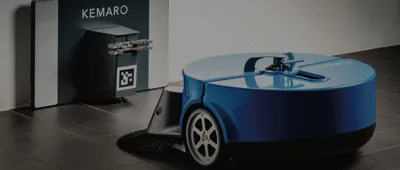
PUDU MT1: the autonomous sweeper for warehouses and factories Best seller
It picks up dust and debris on industrial floors, up to 1,800 m²/h, finds its way with no floor markers and returns to its dock on its own. Pudu has since announced an auto-empty station for the MT1 and MT1 Max.
Distributed by Easy to Clean, an authorised PUDU distributor: free demonstration on your floors, all-inclusive rental or purchase with maintenance.
PUDU MT1 on site
What it brings to your floors
It maps the warehouse and finds its own way
Autonomous navigation with real-time mapping. The MT1 moves between the racks without QR codes or floor rails, and resumes its cycle exactly where it left off.
- Real-time mapping
- Automatic cycle resumption
It picks up dust and debris continuously
High-capacity dry sweeping, designed for heavily soiled industrial floors. The hopper is emptied at the dock, and soon at the auto-empty station announced by Pudu; the robot sets off again while your team stays on the work that matters.

Built for industrial floors
Chassis and brushes sized for extensive surfaces and repeated passes, day and night.
Between racks, among vehicles: the MT1 at work
Manufacturer visuals, in the order of a sweeping cycle.

Sand, shavings, packaging: picked up continuously
High-capacity dry sweeping for heavily soiled floors: dust, sand, packaging debris, over a 70 cm width.
- 1,800 m²/h stated
- 70 cm width

It recognises what lies ahead
On-board vision identifies debris on the floor in real time: it targets dirty areas instead of going over everything.
- Real-time recognition
- Spot mode up to 6,000 m²/h

It maps the warehouse and patrols on its own
Real-time mapping, no QR codes or rails: it moves between racks, spots dirt along its route and resumes its cycle where it left off.
- No floor markers
- Cycle resumption

It shares the aisles with vehicles
Pallet trucks, pickers, trolleys: its multi-sensor perception lets it go around the obstacle and resume its path, in a fully active warehouse.
- Multi-sensor perception

Side brushes reach into the edges
The side brushes pull debris lodged along walls, racks and kerbs towards the intake.

A large bin, emptied in seconds
The 35 L bin covers long runs of aisles. It is emptied at the dock, and the auto-empty station announced by Pudu in September 2026 will take over.
- 35 L bin
- Auto-empty announced

An operator can guide it by hand
For a one-off area or a move, manual mode lets you push it by hand like a conventional sweeper.

It returns to its dock on its own
Auto-docking and charging in under 3 h: it runs day and night, 4 to 8 h depending on mode between charges.
- 4 to 8 h runtime
- Charging in under 3 h
The sites where it fits
The sites where we deploy it, and what we look at during the demonstration.
Warehouses and logistics platforms
Aisles between racks, docks, picking areas: daily sweeping of packaging debris and dust.
Factories and workshops
Circulation routes, storage areas, line surroundings: shavings, sand and dust picked up continuously.
Stockrooms and specialist stores
Stockrooms, receiving areas, aisles in DIY or garden stores.
Before scrubbing
On heavily soiled sites, it sweeps ahead of an autonomous scrubber such as the BG1, which then delivers its full output.
What it changes, and what it does not do
Daily sweeping comes off the schedule.
- Debris and dust picked up continuously
- 1,800 m²/h over a 70 cm width
- No floor markers, cycle resumption
- Runs day and night
Worth knowing before the demo.
- Dry sweeping only: no scrubbing
- Liquids: handled by a scrubber
- Auto-empty: station announced, not yet delivered
- Car parks and semi-open areas: the MT1 Max is better equipped
Why it picks up without going over everything
The principles behind its productivity, and the settings we make at commissioning.
It patrols, then targets
Its camera scans a wide field ahead and recognises debris. On patrol it does not cover the whole area: it goes after what it sees. The manufacturer states 5,000 to 6,000 m²/h in this mode, against 1,800 m²/h in full coverage.
A dust-control fan, not a vacuum
The MT1 does not suck like a vacuum cleaner: a high-flow fan creates an airflow that pushes dust into the bin, and an F9 filter traps it. That is what lets it swallow bottles, plastic film and shavings without clogging.
A mode for heavy dust
Flour, sand, cold-store dust: a dedicated mode adjusts brush and fan speed. The filter needs shaking more often and the bin is emptied sooner: we set that pace during the demonstration.
It backs out of narrow aisles
In an aisle of 75 to 110 cm, too narrow for a U-turn, it drives out in reverse, for up to 40 m. Dead ends between racks are cleaned instead of skipped.
It goes under racks
At 49 cm high, it passes under any obstacle with 52 cm of clearance: rack bottoms, conveyors, packing tables. That is where dust builds up without anyone seeing it.
It gives way to vehicles
It goes around pallet trucks and pickers. In loading areas, we offset its hours from forklift traffic and place its routes away from vehicle circuits.
What running it involves
What is left to do around the robot, and what our service takes care of.
A 35 L bin to empty
The bin is emptied by hand in seconds, at a pace that depends on your site: once a day in a clean warehouse, more often in production. The auto-empty station announced by Pudu will take over.
A filter to shake
The F9 filter is shaken regularly and replaced every 3 to 6 months. We show your team this step at commissioning and check its condition at each visit.
Brushes that last
Side brushes and roller last 6 to 12 months. String, strapping and wrapped film are the first cause of stoppages: a quick check after each task is enough, and replacements are included in our contract.
Six operational questions
What debris does it pick up?
Dust, sand, shavings, paper, plastic film, packaging and bottles up to 50 cl. Items over 25 cm (wooden chocks, bags lying flat), ropes and cables are avoided: they are removed before it goes through.
And liquids?
It absorbs a small puddle under 5 mm as it passes. A real puddle is a job for a scrubber-dryer: the BG1 scrubs behind it on sites that need both.
Which floors?
Smooth or quartz-dressed concrete, epoxy resin, rubber, tiles, paving: indoor hard floors. It crosses 20 mm thresholds and 30 mm gullies, and travels on slopes up to 8°.
Loading docks and pits?
Virtual walls and no-go zones block docks and pits on the map, and its depth sensors detect a drop. Near a dock, we add physical markers as back-up.
Changing floors, going through doors?
It can optionally connect to lifts, automatic doors and gates. Lift control is compatible with the major brands; feasibility is checked with your lift company.
Semi-outdoor areas or a car park?
The MT1 is an indoor machine, rated IPX3 and designed for 0 to 40 °C. For a car park, a yard or a dock exposed to rain, the MT1 Max is built for the job.
Full specifications
Productivity
Capacity & filtration
Runtime & power
Navigation
Size & environment
Upkeep
This model, on rental or purchase
All-inclusive rental
A single monthly fee. The robot, maintenance, parts, consumables, updates and replacement within 72 hours in the event of a breakdown that takes it out of service.
- No deposit and no capital tied up
- An operating expense, off balance sheet
- Model can be changed if your floor areas evolve
Purchase with maintenance contract
The robot goes onto your balance sheet. The maintenance contract that comes with it, which is mandatory, covers preventive servicing, wear parts and software updates.
- A fixed asset depreciated over 4 to 5 years
- You have full use of the equipment
- Quotation drawn up after the demonstration
The demonstration, set-up, training and maintenance are identical in both cases. We compare the two options with you, criterion by criterion.
Compare with the other models
| Model | Key specifications | Ideal for | Profile |
|---|---|---|---|
| PUDU CC1 | 700 to 1,000 m²/h~5 h4-in-1 | Offices, Hotels | View profile |
| PUDU CC1 Pro | 700 to 1,000 m²/hResult-checking camera4-in-1 | Retail, Hotels | View profile |
| PUDU MT1 you are here | 1,800 m²/h70 cm35 L | Manufacturing & factories, Logistics & warehouses | |
| PUDU MT1 Max | 1,800 m²/h70 cm35 L | Manufacturing & factories, Logistics & warehouses | View profile |
| PUDU MT1 Vac | 1,400 m²/h55 cm6 L + 2×7 L | Logistics & warehouses, Manufacturing & production | View profile |
| PUDU BG1 | 2,000 m²/h75 LSweeps + scrubs | Retail & supermarkets, Logistics & warehouses | View profile |
| PUDU BG1 Pro | 3D perceptionCar parks7 cm speed bumps | Car parks, Shopping centres | View profile |
| PUDU SH1 | 27 kg20,000 Pa350 rpm | Restaurants & hospitality, Retail & shops | View profile |
Understanding the PUDU MT1
For decades, an industrial floor was cleaned the same way: everywhere, methodically, whether the surface was dirty or perfectly clean. The MT1 turns that assumption on its head. It is an autonomous sweeper that watches the floor, recognises the debris it comes across and decides for itself to go and collect it. The rest of the time, it patrols.
Read the full guide
A sweeper, not a Swiss army knife
Start with what the MT1 is not: a scrubber-dryer. No water tank, no detergent, no squeegee. It works exclusively dry: it sweeps, it vacuums, it filters the dust. That specialisation is a deliberate choice. The MT1 is the sweeping building block of an ecosystem in which the CC1 models scrub and the BG1 covers very large wet areas.
Its home ground: environments where the soiling is mainly dry. Dust, plastic film, packaging debris, paper, leaves blown in through the doors, cigarette ends at hall entrances.
Spot cleaning, the real signature
The MT1 carries AI cameras that recognise debris on the floor in real time, drawing on a training base that the manufacturer says keeps growing. On patrol, it covers its zone while scanning the floor over a wide field of view; as soon as it spots an item of litter, it leaves its coverage pattern, plots a path and goes to collect it.
This switch from systematic coverage to targeted cleaning is the whole point of the machine. On a site of several tens of thousands of square metres, passing over every square metre makes no sense when most of the surface is already clean. The MT1 is the tool for large volumes with uneven soiling, where intelligent targeting matters more than raw power.
Its home ground: warehouses, factories, retail, transport
Warehouses and factories tick every box: long aisles, permanent dust, localised packaging waste, and runs too long for an operative to cover several times a day. Shopping arcades, with their crumbs and paper, and transport hubs, with their diffuse and unpredictable soiling, round out the target.
Within the MT1 family, the choice is straightforward: the MT1 for conventional industrial interiors, the hardened MT1 Max for semi-outdoor areas and car parks, the MT1 Vac for vacuuming and carpet.
Points to watch, and how our service covers them
The MT1 will never leave a floor gleaming: it collects dry debris, it does not scrub. Its 35 L hopper is emptied by hand, at a rate that depends on the site, until the auto-empty station announced by Pudu on 8 September 2026 becomes available (see our article on the PUDU Auto-Empty Station). And AI targeting, excellent on visible debris, is no substitute for a well-thought-out cleaning schedule.
That is what our service is for: at the demonstration, we set zones, frequencies and emptying intervals against your actual soiling, and the pairing of robotic sweeping with scrubbing at the right frequency is built machine by machine. Maintenance and the 72-hour continuity guarantee are included, as across the whole range.
PUDU MT1 against the other robots
Our detailed comparisons setting the PUDU MT1 alongside the other models, so you can choose with full knowledge of the facts.
The questions we are asked about the MT1
What is the PUDU MT1?
Does the PUDU MT1 scrub the floor?
How much floor does the PUDU MT1 sweep?
What is targeted mode (spot cleaning)?
What debris can the MT1 pick up?
How is the MT1 hopper emptied?
What runtime and what charging time?
Does the MT1 vacuum like a vacuum cleaner?
Can the MT1 work alongside forklifts?
Could the MT1 fall off a loading dock?
Does the MT1 go under racks?
Can the MT1 work in a car park or outdoors?
How much does the PUDU MT1 cost?
MT1 or MT1 Max: which one?
Is the PUDU MT1 right for your floors?
We work it out together during a free demonstration, with no obligation.
Compare with other models
The models this robot is most often weighed against, each with its specifications, its operator review and what its manufacturer does not publish.