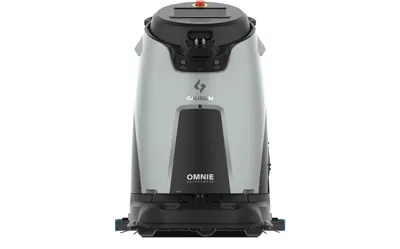
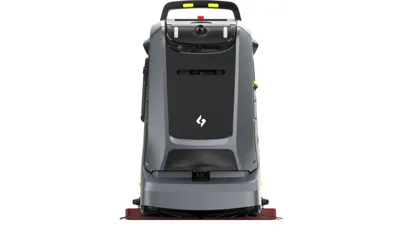
PUDU BG1: the autonomous scrubber-dryer for large sites
It sweeps and scrubs in a single pass, up to 2,000 m²/h, and returns to its station on its own to drain, refill and recharge. The BG1 series launch is covered in a separate news article.
Distributed by Easy to Clean, an authorised PUDU distributor: free demonstration on your floors, all-inclusive rental or purchase with maintenance.
What it brings to your floors
Sweeps and scrubs in the same pass
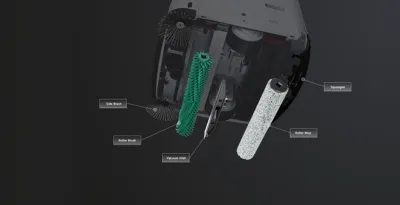
An integrated sweep-and-scrub module picks up debris and scrubs the floor in one run. Over a puddle, the sweeping modules lift so the liquid is not spread; on a stubborn stain, brush pressure increases.
- Sweeping modules lift over liquids
- Extra brush pressure on stains
It detects soiling and targets it in real time
A wide field of view and AI-based vision pick out dry debris and spills on the move. The robot targets the dirty areas rather than going over everything again.
A scrubbing brush that extends towards the edges
The scrubbing brush extends outwards to reach walls and the base of shelving, and a wide cleaning path covers more floor with every pass.
- Extendable edge brush
- Wide cleaning path
Warehouse, factory, supermarket, car park: the BG1 at work
Manufacturer visuals, in the order of the uses we come across in demonstrations.
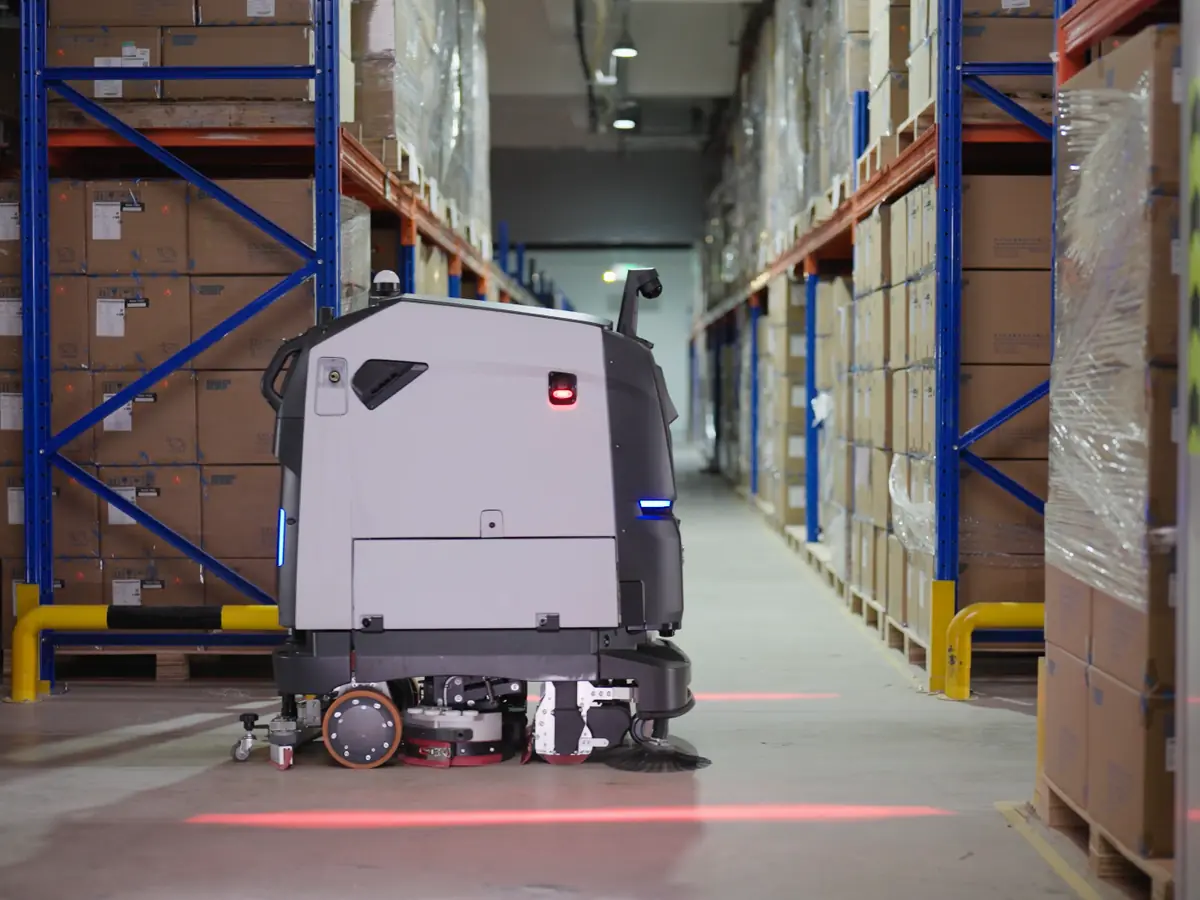
Aisles between racks, scrubbed overnight
On a warehouse floor it sweeps light debris and scrubs behind in the same pass: 55 cm scrubbing width, 70.8 cm sweeping width with its side brush. Aisles of 85 cm and more are enough.
- 2,000 m²/h stated
- 85 cm minimum aisle

A clean, dry production floor for the next shift
Wheel marks, fine dust, splashes: it scrubs and picks up the dirty water behind it, so the floor can be walked on straight away. Areas with heavy debris get the MT1 first.
- Sweeping and scrubbing in one pass
- Dry floor behind the squeegee

Between the shelves, during opening hours
Dust, packaging, spilled liquid: it detects dry and wet dirt in real time and signals its presence to shoppers with lights and sounds.
- Dry and liquid detection
- Light and sound signals
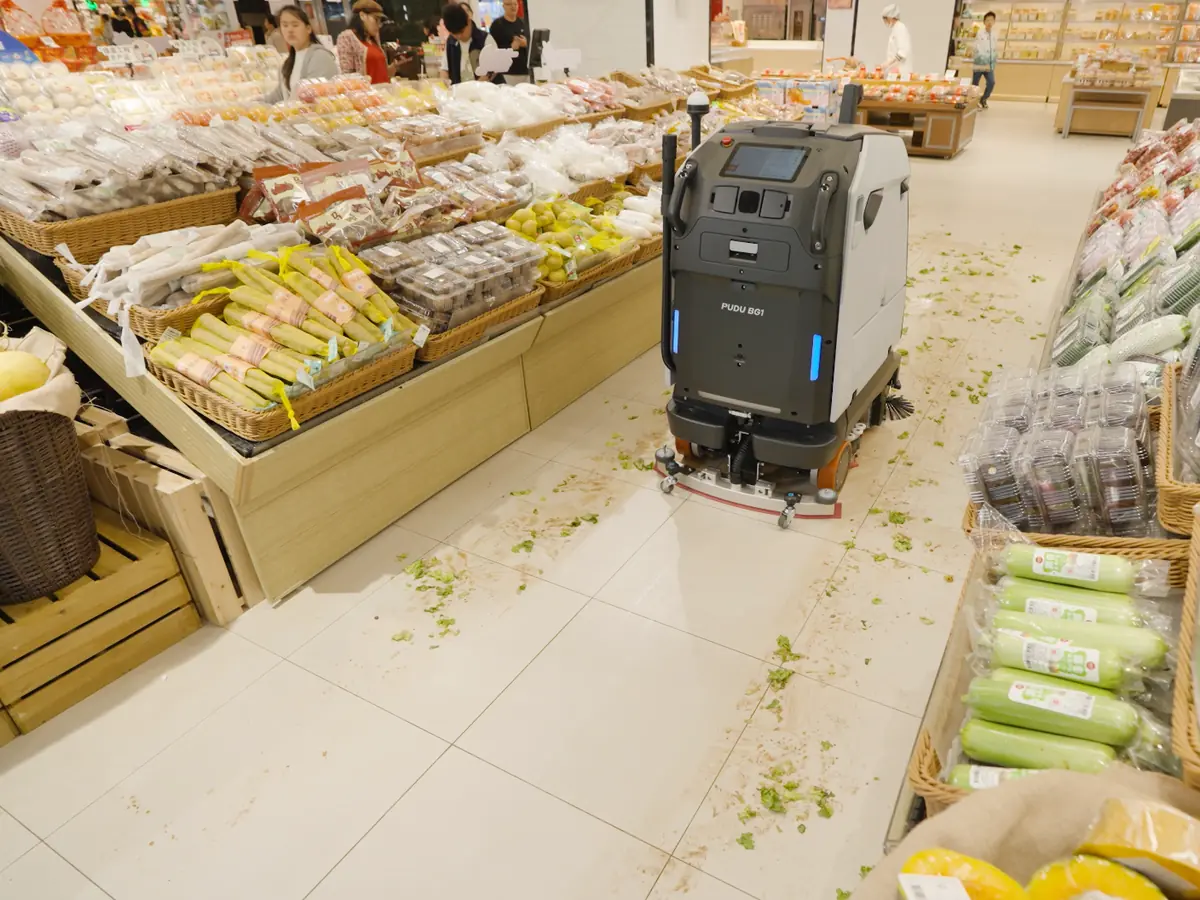
It does not push the puddle ahead
Leaves, packaging, spilled juice in the same aisle: it picks up the dry waste and handles the liquid without spreading it, then dries behind itself. On a lightly soiled floor, no need to sweep first.
- Modules lift on liquids
- Extra pressure on stains
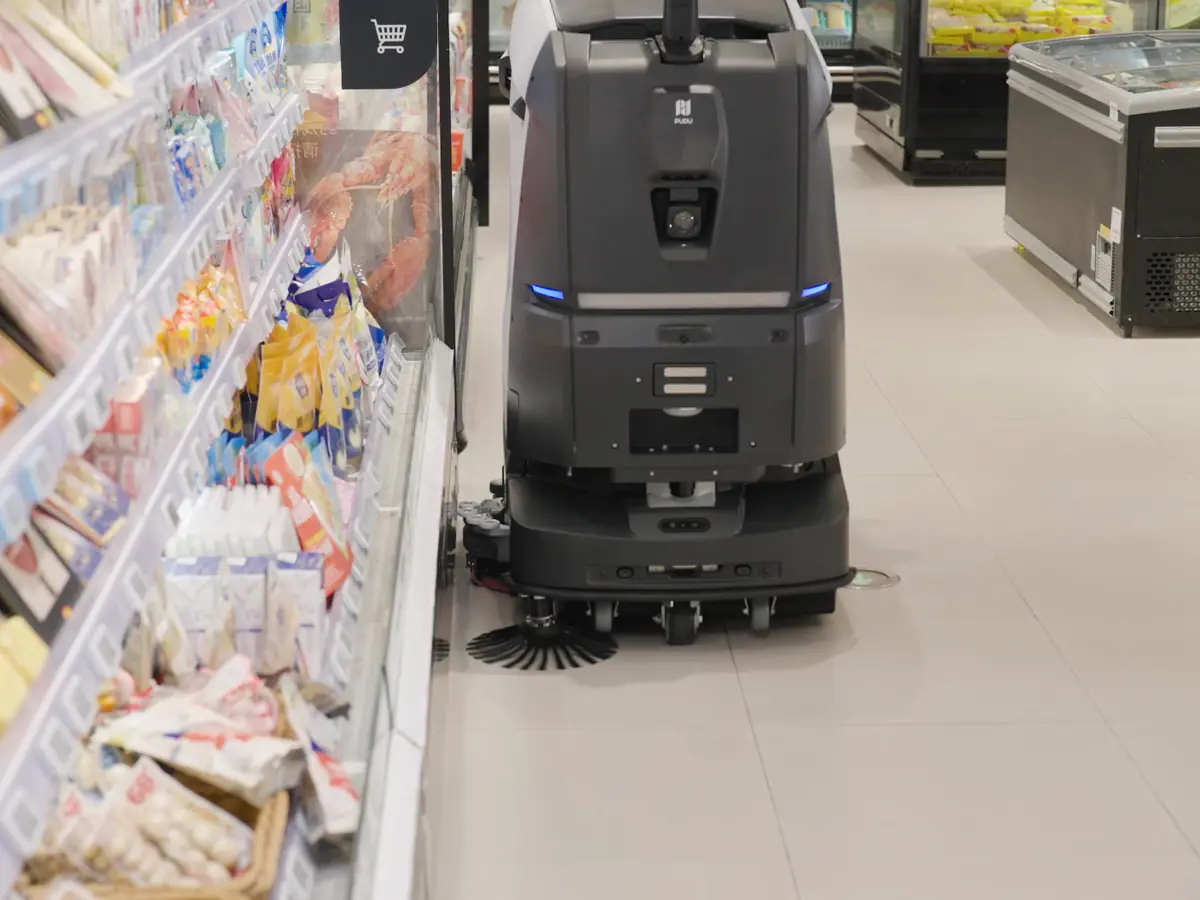
The brush reaches out for the edge
The scrubbing brush extends sideways to scrub at the foot of walls and shelving: less untreated strip to finish by hand.
- Extending edge brush

The large slabs of car parks and halls
In indoor car parks and circulation halls, its 75 L clean water and 60 L dirty water tanks cover long runs of aisles before returning to the station.
- 75 L and 60 L tanks

Detergent dosed to the millilitre
Two detergent tanks, about 7 L in total, and automatic dosing: the right concentration on every pass, with no bucket to prepare.
- 2 tanks, approx. 7 L
- Automatic dosing
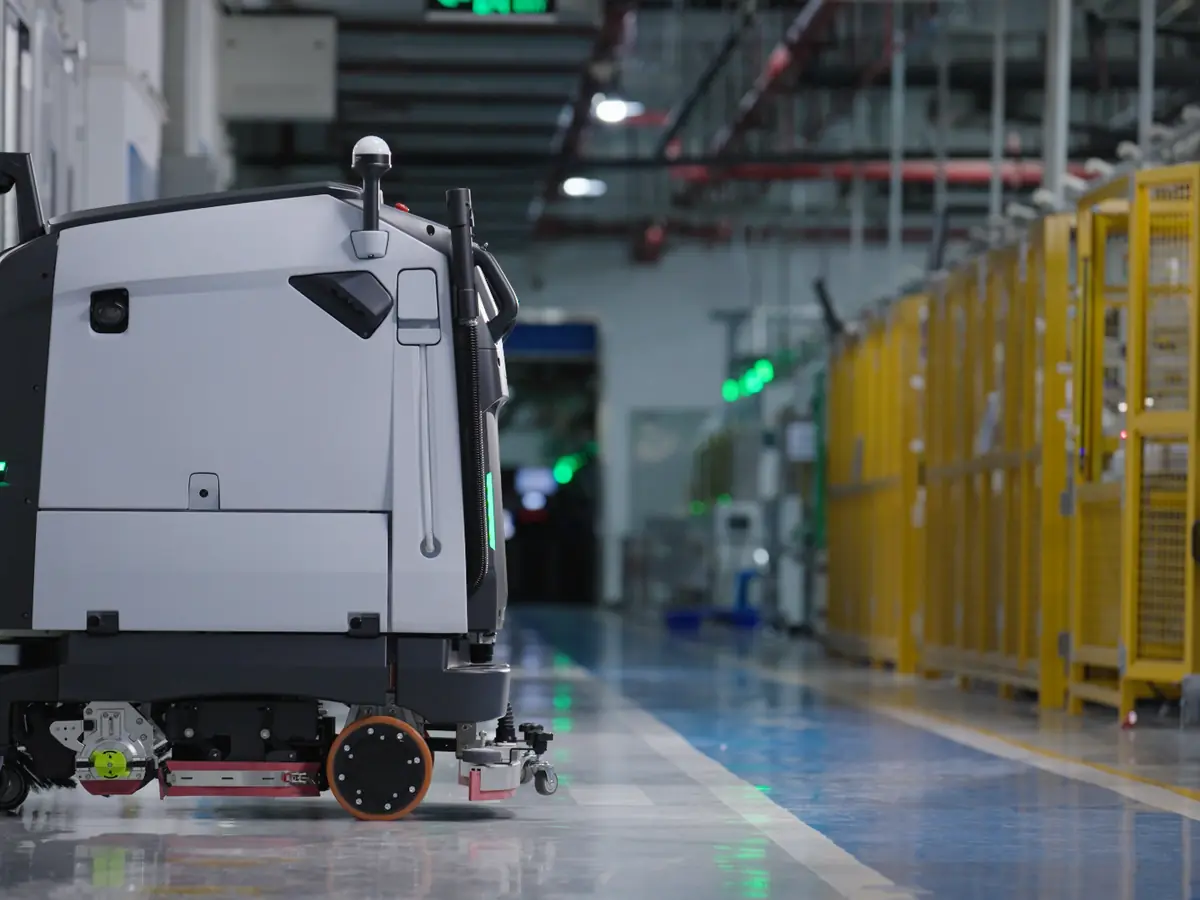
It drains, refills and recharges on its own
At the station it drains the dirty water, refills the clean water tank and recharges, then goes back to the cleaning plan scheduled by zone and time.
- Refill, drain, charge
- 24/7 operation
The sites where it fits
The sites where we deploy it, and what we look at during the demonstration.
Warehouses and logistics platforms
Wide aisles, docks, picking areas: the regular scrubbing the team can no longer keep up with on a ride-on scrubber.
Factories and production sites
Circulation routes, storage areas, line surroundings: a floor scrubbed and dry between two shifts.
Hypermarkets and large stores
Sales aisles, stockrooms, malls: scrubbing overnight or during opening hours, shelf edges included.
Indoor car parks and transport hubs
Large slabs, station or terminal halls: thousands of square metres scrubbed in a night slot.
What it changes, and what it does not do
Scrubbing large areas comes off the ride-on scrubber schedule.
- Sweeping and scrubbing in a single pass
- Up to 2,000 m²/h, 7.5 h runtime in eco mode
- Station: no manual refilling or draining
- Shelf edges handled by the extending brush
Worth knowing before the demo.
- 85 cm minimum aisles: tight areas stay with the CC1 or ET1
- About 348 kg and 1.20 m long: access and goods lifts to check
- Debris over 3 cm: the MT1 goes first
- Hard floors only
- Unveiled in 2026: little hindsight over several years of service
Why it is built this way
The design choices behind its productivity, and what we look at during the demonstration.
Bin at the front, scrubbing brush at the back
A sweeping roller and the side brush send debris up to 30 mm high into a 5 L bin at the front. The disc brush scrubs behind, the squeegee dries. The floor is never scrubbed over grit, which protects the brush and the squeegee.
One side brush, hence a looped route
Its side brush sits on the right. The robot therefore plans a spiral route that keeps the edge on that side, with about 10 cm of overlap between passes. The result: no strip left between two runs.
Two detergent cartridges, not one
Two reservoirs, 7 L in total, can hold two different products: a cleaner and a disinfectant, an acid and an alkaline, or an anti-foam agent. Dosing is set per zone. The circuit accepts pH 2 to 12.
It finds its way under high ceilings
360° 3D LiDAR, front and rear 2D LiDAR, visual localisation effective up to 35 m of ceiling height: warehouse halls and shopping arcades stay readable. A dedicated sensor spots glass walls, a classic trap for laser robots.
It backs out in reverse
When an aisle is too narrow for its 1.40 m U-turn, it drives out in reverse instead of skipping the area. That is what lets it clean dead ends between racks.
Three settings, from quiet to heavy scrubbing
Eco at 62 dB, standard at 68 dB, high at 75 dB: eco mode runs for 7.5 h and covers up to 15,000 m² per charge, high mode handles floors marked by tyre tracks. The choice is made per zone on the map.
What running it involves
What is left to do around the machine, and what our service takes care of.
Three ways to supply water
Automatic filling at the station, semi-automatic filling with an overflow cut-off, or manual filling with a hose. The choice depends on the water supply near the station location; we set it during the site survey.
A few minutes of simple tasks
Empty the debris bin and filter basket, rinse the dirty water tank, check the squeegee: we show your team these steps at commissioning. Everything comes out without tools.
Wear parts you can plan for
Scrubbing brushes every 3 to 6 months, side brush every 4 to 8 months, squeegees and filter at around 6 months, pads every 6 to 12 weeks. In our offer, these replacements are scheduled and included in the contract.
Six operational questions
Where does the station go?
A compact charging post, a nearly flat floor (under 2° of slope) and about 3 m by 2.5 m of clear space in front of it, with a power socket and, ideally, a water supply.
How wide must aisles be?
An 85 cm passage is enough, 1.40 m to turn around. Below that it works in reverse; truly cramped areas go to a compact robot such as the CC1.
Thresholds, gullies, ramps?
It crosses 25 mm thresholds and 40 mm gullies, scrubs on slopes up to 5° and travels up to 8°. A steeper car park ramp is left off the map.
Can it change floors?
The BG1 series works with lifts and automatic doors. At about 348 kg, it needs a goods lift rated for it: we check this with your lift company before any commitment.
What goes in the cartridges?
Low-foam detergents with a pH of 2 to 12. If your site requires a specific product, we validate it during the demonstration, on your floor.
What if an operator needs to drive it?
A ride-on driving accessory, offered as an option across the series, lets someone move it or clean an area on demand outside the scheduled cycles.
Full specifications
Productivity
Tanks & detergent
Runtime & power
Navigation & safety
Size & obstacles
Noise & upkeep
This model, rented or purchased
All-inclusive rental
A single monthly fee. The robot, maintenance, parts, consumables, updates and replacement within 72 hours if a breakdown takes it out of service.
- No deposit, no capital tied up
- An operating expense, off balance sheet
- Swap the model if your floor areas change
Purchase + maintenance contract
The robot goes on your balance sheet. The maintenance contract that comes with it, which is mandatory, covers preventive servicing, wear parts and software updates.
- A fixed asset depreciated over 4 to 5 years
- The equipment is yours to use as you see fit
- Quotation issued after the demonstration
The demonstration, set-up, training and maintenance are identical in both cases. Compare the two models criterion by criterion →
The same logic, two sizes of site
Retail, logistics, manufacturing, transport hubs.
- Sweeping + scrubbing in a single pass
- Extendable edge brush
- Automatic dosing to the ml
- All-in-one docking station
Car parks, shopping centres, uneven sites.
- The same platform, plus:
- 3D LiDAR mapping for car parks
- Crosses 7 cm speed bumps
- Vacuum suction turbine
Compare with the other models
| Model | Key features | Ideal for | Profile |
|---|---|---|---|
| PUDU CC1 | 700 to 1,000 m²/h~5 h4-in-1 | Offices, Hotels | See the profile |
| PUDU CC1 Pro | 700 to 1,000 m²/hResult-checking camera4-in-1 | Retail, Hotels | See the profile |
| PUDU MT1 | 1,800 m²/h70 cm35 L | Manufacturing & factories, Logistics & warehouses | See the profile |
| PUDU MT1 Max | 1,800 m²/h70 cm35 L | Manufacturing & factories, Logistics & warehouses | See the profile |
| PUDU MT1 Vac | 1,400 m²/h55 cm6 L + 2×7 L | Logistics & warehouses, Manufacturing & production | See the profile |
| PUDU BG1 you are here | 2,000 m²/h75 LSweeps + scrubs | Retail & supermarkets, Logistics & warehouses | |
| PUDU BG1 Pro | 3D perceptionCar parks7 cm speed bumps | Car parks, Shopping centres | See the profile |
| PUDU SH1 | 27 kg20,000 Pa350 rpm | Restaurants & hospitality, Retail & shops | See the profile |
Understanding the PUDU BG1
Unveiled in March 2026 and shown at the industry's major international trade fairs shortly afterwards, the BG1 is the large floor scrubber of the range: about 348 kilos built to get through thousands of square metres of hard floor, and above all to do in one movement what the trade has long handled in two: sweep up the dry waste, then scrub and dry behind it.
Read the full guide
Sweeper and scrubber on the same chassis
Most autonomous machines pick a side: dry or wet. The BG1 refuses that compromise. A sweeping module at the front picks up dust, grit, packaging and leaves; a scrubbing module at the rear brushes, wets and dries in the same pass. The robot goes over the floor once, and the floor is clean, dry and ready to walk on.
This single-pass logic is aimed squarely at mixed environments, neither entirely dry nor entirely dirty, where conventional scrubber-dryers struggle: the supermarket aisle where dust sits next to a spill, the goods-in dock between torn cartons and tyre marks, the concourse crossed by thousands of pairs of shoes.
The brush that goes looking for the edges
The historical weak spot of robotic scrubbers is the edge: the untreated strip along walls and shelving that has to be redone by hand. The BG1 tackles it head-on with a disc brush that physically extends, sliding out sideways to scrub as close as possible to obstacles, almost flush with the wall.
On a real site, it is this mechanical detail that protects the productivity gain: less manual touch-up around the perimeter, which is the robot's promise finally kept right up to the skirting board.
Its territory: very large floor areas
Shopping centres, logistics warehouses, transport hubs, hypermarkets, industrial sites: floor areas in the tens of thousands of square metres, wide aisles, heavy traffic and a contractual obligation to deliver results. With a minimum passage width of 85 cm and its overall size, squeezing it into cramped areas would defeat the purpose: there, the compact models in the range do a better job.
The typical profile: the facility manager of a large site, the cleaning manager of a hub, the operator for whom floor area is the first enemy and the night shift the main window.
Points to watch, and how our service covers them
The machine was unveiled in early 2026: its data sheet is better known than its behaviour after three years in service, and that is a reservation we openly acknowledge. Its size calls for clear aisles and a site laid out with it in mind.
This is exactly the kind of risk our model neutralises: the machine remains our responsibility (maintenance, consumables, replacement), continuity is guaranteed within 72 hours, and the demonstration checks beforehand that the geometry of your site matches the format. You are buying a cleaning result, not a technology gamble.
PUDU BG1 against the other robots
Our detailed comparisons setting the PUDU BG1 against the other models, so you can choose with the facts in hand.
The questions we are asked about the BG1
What is the PUDU BG1?
How much floor does the PUDU BG1 clean?
What is the PUDU BG1's runtime?
Does the BG1 clean the edges and the base of shelving?
Do I need to sweep before the BG1 goes through?
Does the PUDU BG1 have a docking station?
Which detergents can be used in the BG1?
What is the difference between the BG1 and the BG1 Pro?
Can an operator drive the BG1?
Does the PUDU BG1 work with the public present?
Can the BG1 use a lift?
How much space does the BG1 station need?
How much does the PUDU BG1 cost?
Is the PUDU BG1 right for my site?
What are the limits of the PUDU BG1?
Is the PUDU BG1 right for your floors?
We work it out together during the free demonstration, with no commitment.
Compare with other models
The models this robot is most often weighed against, each with its specifications, its operator review and what its manufacturer does not publish.