
Floor cleaning techniques: methods, equipment, frequencies, PDF method sheet
9 September 2026 · 12 min read
Damp sweeping, flat mopping, machine scrubbing, vacuuming, the spray method, stripping, crystallisation and disinfection: eight techniques are enough to describe how almost every commercial building is cleaned. This article takes them one at a time, with the equipment, the floors they suit, the frequency and the check to make, then sums everything up in a PDF method sheet you can download without registering.
A cleaning protocol answers three questions for every zone: what, how often, and how. The "how" is the technique. It follows from the floor covering, the type of soil and the level of hygiene required, and it dictates the equipment, the product and the operative time. Here are the eight basic techniques, in the order they come into play, from daily upkeep to full refurbishment.
Damp sweeping
Damp sweeping is the first technique in any cleaning protocol. A trapeze sweeping frame, a damp or pre-impregnated disposable sweeping cloth, and one continuous S-shaped stroke with the frame never lifted off the floor: dust and particles are trapped instead of being thrown back into the air, which is exactly what a dry broom does. That is why the traditional broom has disappeared from commercial environments, from offices to healthcare buildings.
It is done daily on every hard floor, before washing, and on its own it is enough in lightly soiled areas. Equipment: a trapeze frame 40 to 60 cm wide, pre-impregnated or dampened sweeping cloths, and a dustpan and brush for debris. Check: no dust picked up by a fresh cloth wiped into a corner afterwards. The full method, the equipment and the method sheet are in our dedicated article on damp sweeping.
Flat mopping
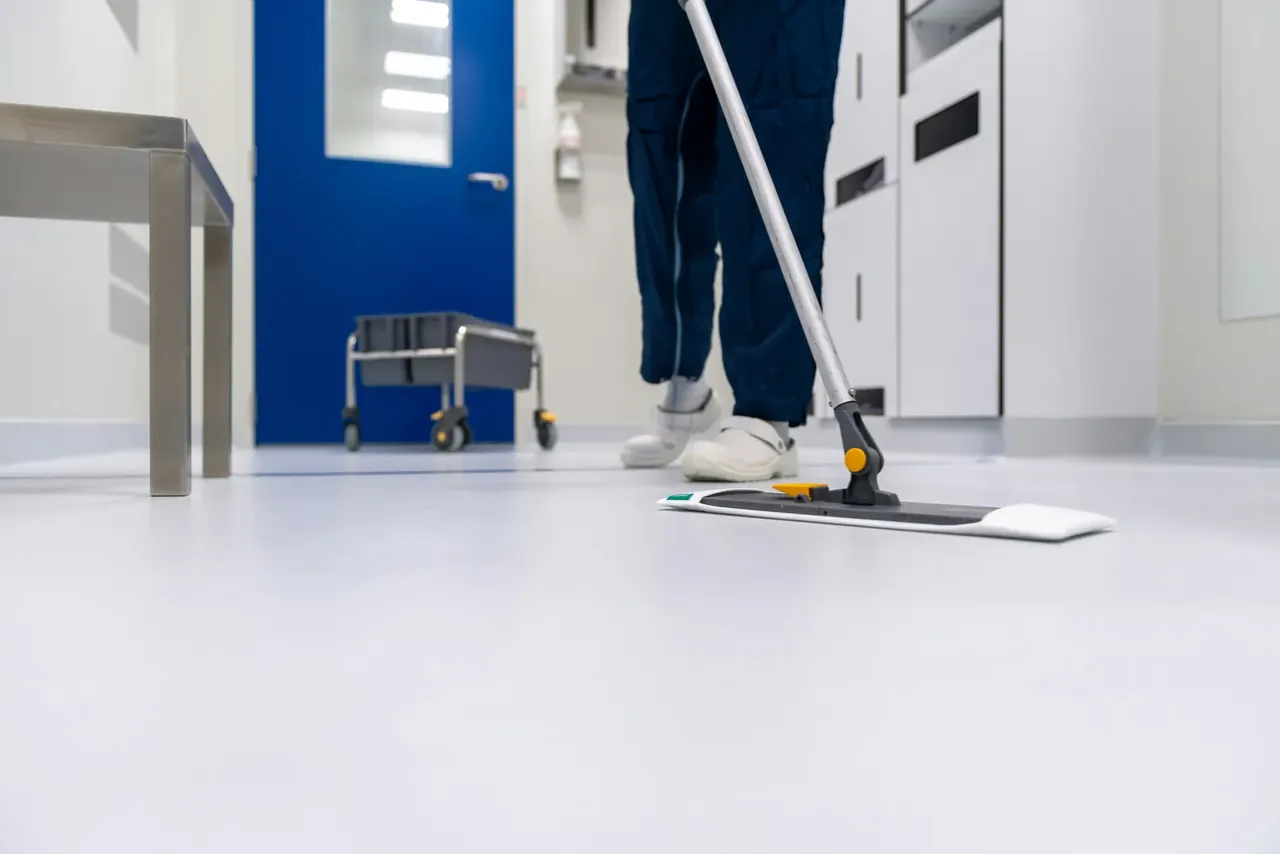
Flat mopping has replaced the rag and bucket in commercial buildings. A microfibre mop head fitted to a flat frame, either pre-impregnated with detergent solution or soaked and then wrung out, washes a defined area in a single pass; the soiled head is swapped for a clean one, never rinsed in a bucket that would simply redistribute the soil. The most common variant is the pre-impregnated method: a batch of heads charged in the morning, one head per room or per zone, and no water carried around the site.
It suits small and medium areas, cluttered spaces, offices, sanitary facilities, bedrooms and corridors. Equipment: a 40 cm flat frame, microfibre mop heads, a wringer or twin-bucket system, and a trolley. Frequency: daily in circulation areas, two to three times a week in offices. Check: the floor is dry within five minutes, with no streaking. The full method, twin-bucket or pre-impregnated, the products and the method sheet are in our dedicated article on flat mopping.
Machine scrubbing: single-disc machine, scrubber-dryer, robot
Beyond a few hundred square metres, flat mopping can no longer keep pace. Machine scrubbing takes over, with three families of machine. The single-disc machine scrubs, burnishes or strips depending on the pad fitted; it needs a trained operator and the water has to be picked up separately. The scrubber-dryer combines brushing, solution metering, a squeegee and suction: the floor is washed and dry in a single pass. It comes in walk-behind, ride-on and autonomous versions. A cleaning robot is an autonomous floor scrubber: it follows mapped routes, works around obstacles and returns to its docking station, with no driver.
Machine scrubbing suits entrance halls, wide corridors, sales floors, warehouses, workshops and any open hard floor. Frequency: daily to weekly depending on traffic. Check: no squeegee marks and no missed patches, something a robot's cleaning report documents automatically. Choosing between the three families is a question of area, clutter and available time slots; our guide to choosing a commercial cleaning robot covers the last case in detail.
Vacuuming
Vacuuming is the technique for textile and resilient floors, and also for corners, skirting boards and high surfaces. A dry vacuum with HEPA filtration holds fine particles instead of blowing them back out; a wet and dry vacuum handles damp areas and heavy debris. On carpet, regular vacuuming is what prevents soil building up in the pile and pushes back the next deep clean.
Frequency: daily on carpeted circulation routes, weekly in offices, and every visit for corners and skirting boards. Equipment: a backpack or cylinder vacuum, brushes matched to the covering, and HEPA filtration in sensitive environments. Some robots vacuum the carpet on office floors alongside scrubbing the hard floors. Check: no lint or visible dust when seen against the light. Full carpet care, including hot water extraction, is in our carpet method sheet.
The spray method and burnishing
On a floor protected by a polish (PVC, linoleum, poured floors), the spray method maintains that protection without removing it: you spray a spray-method product over small sections and pass the single-disc machine with a red or beige pad. The film is cleaned, restored and glossy again. High-speed burnishing, with a machine at 400 rpm or more and a white pad, brings back the shine with no product at all or with a burnishing fluid.
Both techniques stretch the interval between two strippings, which is the heaviest job of all. Frequency: weekly to monthly depending on traffic, on a clean and dry floor. Equipment: a single-disc machine at 400 to 1,500 rpm, a sprayer, and red, beige or white pads. Check: even gloss, with no dried spray marks.
Stripping and refurbishment
Once the protective film is worn, stained or soiled right through, it has to come off completely: that is stripping. Apply a stripper, work it mechanically with a single-disc machine and a black or green pad, pick the slurry up with a wet and dry vacuum, rinse thoroughly, let the floor dry, then lay two or three coats of fresh polish. A refurbishment covers the stripping and the new protection, and sometimes the replacement of the joints as well. The full method for refurbishing resilient floors, stripping, polish and routine upkeep, is in our article on floor sealing and polish.
Frequency: once or twice a year, or when the cleaning contractor changes, when the site moves or after building works. It is a heavy job, to be scheduled when the site is closed: it takes the area out of use for 24 to 48 hours. Check: no old polish left in the corners, and a new film that is even and free of bubbles.
Crystallisation of stone floors
Marble, travertine and limestone are not protected with a polish but by crystallisation: a chemical reaction between a crystallising product and the lime in the stone, driven by a single-disc machine with steel wool or a dedicated pad, which hardens the surface and brings back its lustre. Granite, which contains no lime, can be burnished but cannot be crystallised. Our article on crystallising marble and limestone floors sets out the method, the frequency and the upkeep that makes it last.
Frequency: every three to six months in busy entrance halls, once or twice a year elsewhere, preceded by a light strip if the stone is soiled. Check: an even mirror gloss with no white haze. This is specialist work, often subcontracted, and daily damp sweeping plus neutral flat mopping is what makes it last.
Disinfection and bio-cleaning
Disinfection never replaces cleaning, it follows it: you destroy micro-organisms on an already clean surface, using a biocide that meets EN 14476 or EN 13697 (European test standards) depending on the target, and you observe the stated dwell time. Bio-cleaning, the French healthcare term for the full clean, rinse and disinfect sequence, is the rule in hospitals, care homes, nurseries and kitchens.
Frequency: daily on touch points and in sanitary facilities, several times a day in clinical areas, according to how the risk zones are classified. Our guides go into detail on floor disinfection and on the bio-cleaning protocol for care homes and hospitals.
Which technique for which floor: the table
The floor covering dictates the technique. This table sums up the usual pairings; each site's protocol then adjusts them to its traffic and to the level of hygiene required.
| Floor covering | Routine upkeep | Periodic work | Refurbishment |
|---|---|---|---|
| Ceramic tile, porcelain stoneware | Damp sweeping, flat mopping or machine scrubbing | Machine scrubbing, grout cleaning | Stripping, descaling |
| PVC, linoleum, sealed poured floors | Damp sweeping, neutral flat mopping | Spray method, burnishing | Stripping and fresh polish |
| Resin, power-floated concrete | Damp sweeping or sweeper, machine scrubbing | Machine scrubbing at high brush pressure | Degreasing, industrial refurbishment |
| Marble, limestone | Damp sweeping, neutral flat mopping | Burnishing | Crystallisation |
| Granite, non-calcareous stone | Damp sweeping, flat mopping or machine scrubbing | Burnishing | Light stripping, grinding |
| Carpet, textile | Vacuuming | Spot removal, dry foam shampoo | Hot water extraction |
| Wood, laminate | Damp sweeping, well-wrung flat mopping | Suitable burnishing | Sanding and sealing (specialist) |
| Sports floors | Damp sweeping, flat mopping or a low-water scrubber-dryer | Deep cleaning of the markings and playing areas | Stripping specific to the covering |
The PDF method sheet
Summary sheet, free to use. The eight techniques on two pages, each with its equipment, floors, frequency and check, ready to pin up in the cleaning store or attach to a specification: Download the techniques sheet (PDF, in French) → The protocol template and the monitoring and traceability sheets are gathered on our cleaning templates download page.
What the robot mechanises, what your team keeps
A cleaning robot does not add a ninth technique: it mechanises two of the eight, sweeping and scrubbing, on large open areas, with constant solution metering and a cleaning report at every cycle. Everything else, the edges and corners, the cluttered spaces, the sanitary facilities, the high surfaces, the spray method, stripping, crystallisation and disinfection, stays with your team. That is the principle of cobotics: the machine covers the surface, people keep the technique.
In a cleaning protocol, this shows up as two separate lines for the floors: the machine pass, its frequency and its time slot on one side, and the manual finishing on the other. That is how we organise our robotic floor cleaning service on client sites, in support of the teams already in place.
Frequently asked questions
What are the main floor cleaning techniques?
What is the difference between cleaning and disinfection?
What is damp sweeping?
Which technique for which floor?
Does a cleaning robot replace these techniques?
Where can I find a floor cleaning method sheet in PDF?
A question about your own site?
Write to us and we will reply within one working day. If you want to go further, the demonstration takes place on your own floors, free of charge.