
Cleaning commercial carpet: routine maintenance, spot removal, shampooing and hot water extraction, with the method sheet to download
9 September 2026 · 7 min read
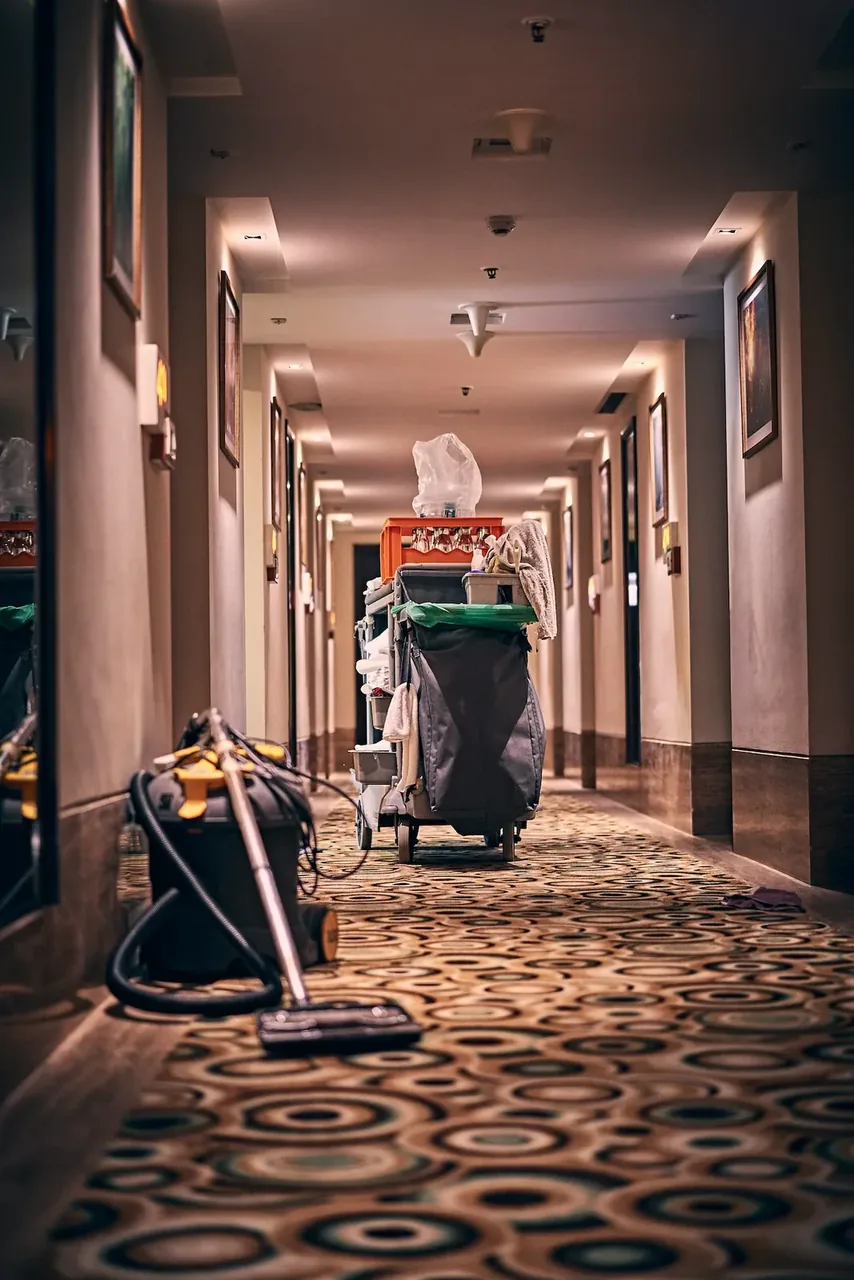
Carpet is the most comfortable floor covering in offices and hotels, and the worst maintained: it gets vacuumed, more or less, and nobody calls a specialist until it has turned grey. Yet carpet can be cleaned right down to the backing, it recovers its colour, and it lasts twice as long when it is treated as a floor in its own right, with regular routine maintenance, immediate spot removal, interim shampooing and, once or twice a year, hot water extraction. This article sets out the four levels of maintenance for commercial carpet, the method and the equipment for each, the frequencies by type of premises, the mistakes that ruin a carpet faster than soil ever will, and the way an autonomous vacuum or a multifunction robot takes on the first level, the most repetitive one. The method sheet is available as a PDF.
The four levels of carpet maintenance
Carpet gets soiled in two ways. By dry particles, sand, dust and fibres, carried in on shoes and dropped down between the tufts: they are abrasive and, with every footfall, they cut the fibres and turn the pile grey. That is wear. And by greasy soil and stains, coffee, ink, fats, mud, which bind to the fibre and hold dust. That is soiling. Maintenance answers both, at four levels that build on one another.
| Level | What it deals with | Method | Typical frequency |
|---|---|---|---|
| 1. Vacuuming | Dry particles, before they wear the fibre | Brush-roll vacuum, slow crossing passes | Daily in corridors and entrance halls; 2 to 3 times a week in offices; daily in occupied hotel rooms |
| 2. Spot removal | Individual stains | Blot up, suitable spotter, work from the edge inwards, rinse, dry | Immediate |
| 3. Interim shampooing | Surface soiling on traffic lanes | Dry foam with a single-disc machine, or absorbent dry compound brushed in then vacuumed out | Every 1 to 3 months on traffic lanes |
| 4. Hot water extraction | Deep soiling, restoration | Solution injected under pressure and extracted, after pre-treatment | 1 to 2 times a year; more often in hotels |
Vacuuming: 80% of the job
Nothing replaces vacuuming. It lifts the particles before they cut the fibres, and a carpet vacuumed every day ages half as fast as one vacuumed once a week. The equipment matters: a brush-roll vacuum agitates the particles lodged between the tufts, where a plain floor tool only skims them; a HEPA filter holds back the fines; a large-capacity bag avoids losing suction. The method matters just as much: slow, crossing passes in two directions, overlapping by a third, with extra attention on the traffic lanes, the entrances and the foot of each desk. A vacuum pushed quickly picks up half of what it could.
This is the level that robotics takes on most naturally. A commercial autonomous vacuum such as the PUDU MT1 Vac vacuums the carpet on office floorplates at night, at a rated 1,400 m²/h, gets under desks and sofas, and logs every pass; a multifunction robot such as the PUDU CC1 vacuums the carpet and scrubs the hard floors on the same floorplate. Your team keeps the edges, the stairs, the cluttered areas and the levels above.
Spot removal: straight away, and never by rubbing
- Blot first. Liquid: blot with an absorbent white cloth, without spreading it; solid or pasty: scrape it off with a spatula; dry: vacuum it up.
- Identify the stain. Water-based (coffee, tea, juice, drinks), greasy (oil, make-up, ink), protein (blood, milk), mud, chewing gum: each family has its own spotter.
- Test the product in a hidden corner: some fibres and dyes do not tolerate solvents or oxidising agents.
- Apply to the cloth, not to the carpet, blot from the edge inwards, move to a clean part of the cloth for every blot, and never rub: rubbing mats the pile and spreads the stain.
- Rinse by blotting with clean water, absorb, then dry with a dry cloth or a dryer; on a damp spot, leave weighted absorbent paper on it overnight.
- Chewing gum is frozen with a freezer spray and broken off; older stains are a matter for shampooing or hot water extraction.
Interim shampooing: dry foam or dry compound
Between two hot water extractions, the traffic lanes pick up surface soil and go grey. Two quick low-moisture methods bring them back without taking the space out of use. Dry foam: a carpet shampoo is turned into foam by a generator or by a single-disc machine fitted with a soft brush; the foam encapsulates the surface soil, dries in one to two hours and is vacuumed out with it. Absorbent dry compound: a compound impregnated with solvent and detergent is spread, brushed into the pile with a single-disc machine or a counter-rotating brush, left to work for fifteen to thirty minutes, then vacuumed up; the space can be used again immediately. Both methods treat the surface, not the depth; they space out hot water extractions, they do not replace them. Frequency: every one to three months on the traffic lanes, the entrances and the counter areas; on an ad hoc basis elsewhere.
Hot water extraction: the full method
Hot water extraction is the deep cleaning of carpet: a detergent solution is injected into the pile under pressure, it releases the soil right down to the backing, and the same machine immediately extracts it along with the solution. Done well, it gives a carpet back its colour and its bounce; done badly, it leaves it damp, matted, ringed and smelling, and it is the method most often done badly.
- 1. Vacuum thoroughly. A carpet that has not been vacuumed turns to mud under injection; this is the step people skip, and it decides the result.
- 2. Pre-treat. Spray a pre-spotter or a pre-spray onto the traffic lanes and the stains, leave it to work for ten to fifteen minutes, brush lightly. Treat the stains you have identified.
- 3. Dilute correctly. A low-foaming detergent made for hot water extraction, at the dilution given on the technical sheet, in warm water (40 to 50 °C depending on the fibre; never hot on wool). A high-foaming or alkaline product damages the fibre and leaves a film that re-soils.
- 4. Inject and extract. Slow, even, overlapping passes, drawing the machine towards you; on heavily soiled areas, one injection pass followed by two dry extraction passes. Never saturate: the carpet should be damp to the touch, not wet.
- 5. Rinse with clean warm water on heavily treated areas, to remove detergent residue.
- 6. Lift the pile with a pile brush or a broom, working with the lay of the pile, so that it dries evenly and without marks.
- 7. Dry. Six to twelve hours, with forced ventilation or air movers, the area closed off, furniture put back on blocks or only once drying is complete. A carpet put back into use damp re-soils within days, mats and smells.
The equipment: a commercial hot water extraction machine with a solution tank, a recovery tank, an adjustable-pressure pump and a suitable tool (roller or brush), air movers, a pre-spotter, a hot water extraction detergent and a spotting kit. The frequency: once a year in offices, twice in high-traffic corridors and hotels, more in entrance halls and restaurant areas; and whenever a tenant leaves or a restoration is due.
The mistakes that ruin a carpet
- Too much water. The leading cause of ruined carpet: a soaked backing, delamination, mould, rings, smells. Hot water extraction leaves the pile damp, not wet, and then dries it.
- The wrong product. A hard-floor detergent, an alkaline, a high-foaming or a chlorinated one: discoloured fibre, matted pile, sticky film.
- Rubbing a stain. The pile mats and the stain spreads; blot instead.
- Skipping the vacuum before shampooing or extraction: the particles turn to mud.
- Putting a damp carpet back into use: immediate re-soiling, footmarks, smell.
- Neglecting entrance matting: three paces of matting hold back most of the grit that wears the fibres; it is maintained like the carpet itself.
- Waiting until the carpet has gone grey before acting: by then the fibres are cut and no method repairs them.
Carpet and the robot: who does what
On an office floorplate or in a hotel, the cobotic split is clear. The robot holds level 1: the daily vacuuming of large carpeted areas, at night or early in the morning, under the furniture, with a consistency no one can sustain by hand across thousands of square metres; it logs its passes, which feeds traceability. Your team holds levels 2 to 4, spot removal, shampooing and hot water extraction, which call for a diagnosis, a product and a skilled hand; and it keeps the edges, the stairs and the cluttered areas of level 1 as well. Our pages on robotic cleaning in hotels and robotic cleaning in offices describe that organisation; our guide to the robots on the market lists the autonomous vacuums and multifunction machines that handle carpet.
The carpet maintenance method sheet (PDF)
Free to use, no sign-up. The four levels, the seven steps of hot water extraction, spot removal by stain family, the frequencies by type of premises and the mistakes to avoid, on a single page. Download → (PDF, in French) All our templates are gathered on the downloadable cleaning templates page.
Frequently asked questions
How often should commercial carpet be cleaned?
What is hot water extraction?
How do you remove a stain from a carpet?
Can a carpet be shampooed without taking the space out of use?
Can a robot clean carpet?
Why does my carpet re-soil so quickly after cleaning?
A question about your own floors?
Write to us and we will reply within one working day. If you want to go further, the demonstration takes place on your own floors, free of charge.