
Damp sweeping: the method step by step, the equipment, the mistakes to avoid, and the method sheet to download
9 September 2026 · 6 min read
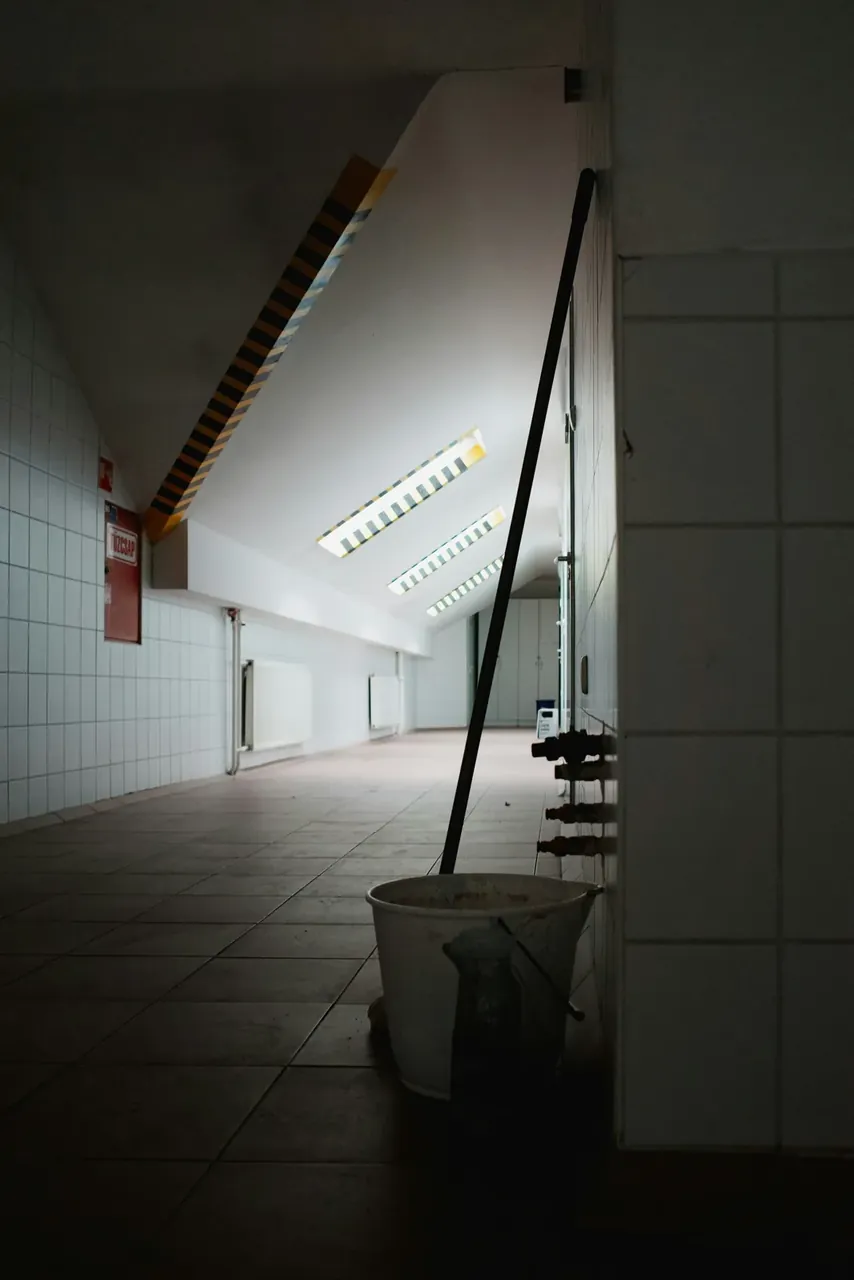
Damp sweeping is the first technique in any cleaning protocol, and the one most often done badly. A trapezoid sweeping frame, a damp sweeping cloth, one continuous movement: the principle fits in a sentence, yet the gap between damp sweeping done properly and damp sweeping that throws dust back into the air is visible against the light in any corridor. This article explains why the technique replaced the dry broom in commercial premises, sets out the method step by step, the equipment, the floors and the frequencies, the most common mistakes, and how mechanised and robotic sweeping extend the same principle across large areas. The method sheet can be downloaded as a PDF. The next step in the protocol, flat mopping, has a method sheet of its own.
Why the dry broom has disappeared from commercial premises
A dry broom does not clean, it displaces. Every stroke lifts the finest particles, mineral dust, textile fibres, skin flakes, pollen and spores, which stay airborne for several minutes before settling again on the surfaces just cleaned, on the furniture, and in the airways of anyone present. In a healthcare building those particles carry micro-organisms; in a food processing plant they contaminate the lines; in an office they are the reason the dust is back on the screens the next morning. Hospital hygiene guidance ruled out dry sweeping as early as the 1990s, and commercial cleaning protocols followed: damp sweeping is now the reference technique for removing dust from a hard floor.
The principle rests on the moisture in the cloth: particles stick to a damp surface instead of being flicked away by a dry one. The sweeping frame, wide and flat, keeps the cloth in constant contact with the floor; the continuous movement prevents the lift that would release the particles again. The result is a floor free of dust with no cloud, ready to be mopped or, in lightly soiled areas, simply clean.
The method step by step
- 1. Prepare. A trapezoid sweeping frame of 40 to 60 cm depending on the width of the room (40 cm in cluttered offices, 60 cm in corridors and entrance halls), a damp or pre-impregnated cloth fitted to the frame, a dustpan and hand brush for larger soil, and a bag for used cloths. Pick up bulky items by hand (paper, packaging) before you start.
- 2. Start at the far end. Begin at the point furthest from the door so that you never walk back over a swept area. Clear the corners and edges first, drawing the frame along the skirting.
- 3. The S pattern. Push the frame ahead of you in a continuous S shaped movement, the cloth always in contact with the floor, never lifting the frame and never going back over your work. The frame moves at the pace of a slow step; the particles gather in front of the cloth and on it.
- 4. Do not lift. This is the rule that makes the difference: a frame that is lifted releases what it has captured. Go around obstacles, pivot at the end of a run, but do not lift.
- 5. Finish at the door. Gather the soil near the door and pick it up with the dustpan and hand brush, rather than pushing it under the furniture.
- 6. Change the cloth. One cloth per room, or per zone of 60 to 100 m² depending on how dirty the floor is, dropped into the bag as it is, without shaking. A saturated cloth no longer captures, it spreads.
- 7. Check. A clean cloth wiped into a corner after sweeping should pick up nothing; held against the light, no dust should be floating.
The equipment
| Item | Choice | Why |
|---|---|---|
| Trapezoid sweeping frame | 40 cm (offices, bedrooms), 60 cm (corridors, halls), hinged head, telescopic handle | Width matched to the room, constant contact with the floor, ergonomics |
| Pre-impregnated cloth | Non-woven, single use, impregnated with a dust-binding solution | High retention, no preparation, hygiene (one cloth per room) |
| Dampened cloth | Dry non-woven cloth dampened with water or a neutral solution sprayed on before use | Cheaper, but the dampening has to be even |
| Reusable microfibre cloth | Machine washable at 60 °C | Economical in volume, to be kept for low-risk areas |
| Dustpan and hand brush | Lipped dustpan, soft-bristled hand brush | Final pick-up without dispersal |
| Bag for used cloths | On the trolley | No used cloth left on the floor or shaken out |
The pre-impregnated cloth is the reference in healthcare, in food processing and anywhere hygiene comes first; the dampened cloth suits ordinary office work; reusable microfibre earns its place over large, less sensitive areas. The frame is never shared between the toilets and the rest of the building: a dedicated, colour-coded frame for the toilets prevents any transfer.
Floors, frequencies and place in the protocol
Damp sweeping suits every hard floor: ceramic tile, porcelain stoneware, vinyl, linoleum, resin, power-floated concrete, stone and marble, as well as floors that do not tolerate water such as sealed wood and laminate, for which it is often the only acceptable daily technique. It does not apply to textiles, which call for vacuuming, nor to floors heavily soiled with coarse debris, which call for mechanised sweeping or a pick-up beforehand.
It is done daily in circulation areas, offices, bedrooms, classrooms and shops, several times a day in busy entrance halls and toilets, and it always comes before mopping: mopping a floor from which the dust has not been removed turns that dust into slurry and wears out mop heads and brushes. In lightly soiled areas it is enough on its own between two mopping rounds. The cleaning protocol puts it at the head of every zone, and our guide to floor cleaning techniques places it among the eight basic methods.
The most common mistakes
- Lifting the frame. To get around a table leg, cross a threshold or go back over a spot: every lift releases the particles already captured. Go around, pivot, do not lift.
- Shaking the cloth. Into the bin or out of the window: the dust goes straight back into the air. The cloth goes into the bag as it is.
- One cloth for the whole floor. Once saturated it spreads soil; one cloth per room or per zone.
- A cloth that is too wet. It leaves marks and glues the particles to the floor instead of picking them up; damp, not wet.
- Starting at the door. You walk back over your own work; go from the far end towards the door.
- A single frame for the toilets and the offices. Cross-contamination; use a dedicated, colour-coded frame.
- Going too fast. At normal walking pace the cloth lifts off the floor; the S pattern is done at a slow step.
Mechanised and robotic sweeping
Beyond a few hundred square metres the sweeping frame can no longer keep up, and the damp sweeping principle transfers to machines: a mechanised sweeper, ride-on or autonomous, captures dust and debris with brushes and filtered suction instead of throwing them back into the air, which is exactly what the damp cloth is for. In a warehouse, a car park, a workshop or a shopping mall, an autonomous sweeper of 70 to 120 cm keeps concrete dust under control every day, ahead of the mopping round, and issues a report of each run; cluttered areas, edges and corners stay with the sweeping frame. That is the division of work we organise in our robotic floor cleaning service: the machine covers the open area, your team keeps the technique. The autonomous sweepers on the market are compared in our autonomous sweeper category.
The damp sweeping method sheet (PDF)
Free to use, no registration. A single page to pin up: the method in seven steps, the equipment, the golden rules, the floors and frequencies, and the checkpoints. Download (PDF, in French) → All our templates are gathered on the cleaning templates page.
Frequently asked questions
What is damp sweeping?
Why stop sweeping dry?
Pre-impregnated cloth or dampened cloth?
How many square metres per cloth?
Can damp sweeping be used on a wooden floor?
Does a robot do away with damp sweeping?
A question about your site?
Write to us and we will reply within one working day. If you want to go further, the demonstration takes place on your own floors, free of charge.