
Gausium Scrubber 50 Pro · specs, operator review and alternatives (2026)
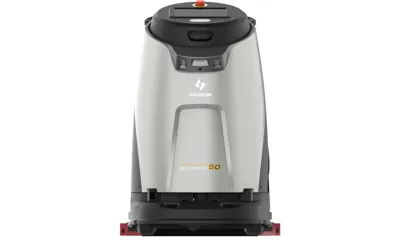
The Gausium Scrubber 50 Pro is a mid-range autonomous floor scrubber from the Chinese manufacturer Gausium, launched in 2021. It scrubs a 460 mm path in the disc-brush configuration and 780 mm with the roller, carries 30 L of clean water and 24 L of recovery water, and is rated at 1,987 m²/h, more like 500 to 1,300 m²/h in real conditions. Its 60 Ah LiFePO4 battery recharges in 2 hours for 3 to 8 h of runtime depending on the mode. It navigates with 2D LiDAR and 3D depth cameras using multi-map SLAM, and pairs with a charging dock and a water station to run cycles back to back autonomously. Price and availability on request. Known references: Madrid metro, Salzburg airport, Mömax.
At a glance
Technical specifications
Reading by environment
An operator's reading grid, derived from the published specs. Each verdict follows from the figures in the table, not from deployment feedback.
| Criterion | What the specs say | Verdict |
|---|---|---|
| Surface bracket | 30 L clean water + 5-stage recycling (up to 80% saved); ≈ 900 m²/h observed; 3 h scrubbing; 2 h recharge | Counter-intuitive: the 30 L tank is not the limiting factor, thanks to water recycling. It is the battery that caps the pace: one scrubbing charge covers ≈ 1,500 to 2,700 m², and with a resume after recharging, one machine handles ≈ 3,000 to 5,000 m² of hard floor per operating slot. Tipping point: above roughly 5,000 m²/day AND in clear aisles of 1.4 m or more, the Scrubber 75 (75 L tank, 750 mm width, ≈ 1,050 m²/h observed) finishes in one cycle what the 50 does in two. But the 75 weighs 400 kg and needs a 1.4 m aisle: in cluttered retail or partitioned offices it does not fit, and the Scrubber 50 remains the right choice even at higher volumes. |
| Footprint / aisles | Minimum passage width 800 mm · turning width ≈ 1,100 mm `[TO BE CONFIRMED]` | At ease in standard retail and office aisles. Blocked below 800 mm and struggles in very cluttered zones: for tight shelving runs, prefer a compact such as the Phantas. |
| Floors and soiling | Disc or roller brush · debris tray only 1.2 L · 4.6° gradient · carpet n/p | Hard floors only (concrete, ceramic, epoxy, PVC, stone, granite, artificial marble). This is a scrubbing machine, not a sweeper: its core target is adherent and greasy soiling and wet marks. For bulky solid waste, its 1.2 L tray is not enough; pre-sweeping is required. Details by type of soiling in the matrix below. 4.6° gradient ≈ 8%: clears a standard accessibility ramp (5%) but not a steep loading bay. Do not plan it for carpet. |
| Public / hours | IEC 63327: conforming on request (not certified as standard) · noise level n/p | For use with the public present (public-access buildings, open retail, healthcare lobbies), require the IEC 63327 certified configuration contractually: it is not standard. Failing that, restrict it to slots without the public (night, before opening). As the noise level is not published, validate it before any daytime use in offices or healthcare. |
| Plumbing | Optional water station · optional charging dock | Without the water station, the 30 / 24 L tanks mean regular manual drains and refills. With dock and station, the machine runs cycles back to back autonomously, without plumbing work. Both stations are options: full autonomy costs more than the machine alone. |
| Operating profile | Purchase (capex) or RaaS (opex) · app / cloud supervision | Buying also means operating: training, daily maintenance, supervision, managing continuity in the event of a breakdown. Outsourcing the service transfers that workload. Detailed framing further down. |
Floors and soiling: what the machine really handles
The floor type alone is not enough to decide: it is the floor × soiling pairing that governs. The same soiling is not treated the same way depending on its nature and, above all, its quantity. The Scrubber 50 Pro is a scrubber-dryer: it scrubs, it does not sweep. Here is what it handles, and what needs doing before it.
| Type of soiling | The Scrubber 50 Pro | What to plan for |
|---|---|---|
| Adherent and greasy soiling, wet marks (shoe scuffs, greasy films, drips, ingrained dirt) | Core target. Brush + water + detergent, 5-stage recycling; disc for smooth floors, roller for textured or heavily soiled floors. | Nothing: this is exactly its job. |
| Dust and fine dry soiling | Handled by scrubbing, but it wets the floor. | On a floor that does not tolerate water, or for simple dry dusting, a vacuum or a dedicated dust-removal pass does better and faster. |
| Solid waste, large volumes (debris, packaging, leaves, grit) | Out of scope. The 1.2 L tray fills quickly and there is no powerful sweeping; running the scrubber over it clogs the squeegee and spreads the dirt. | Pre-sweep (by hand, with a sweeper or a sweeping robot), or choose a sweeping machine with a large debris hopper. |
| Mixed soiling (bulky and fine together) | Does not do everything in one pass. | Mandatory sequence: remove the bulk first, then scrub. This is the key principle for any real site. |
This sequencing principle applies beyond this robot. On awkward floors with light soiling, a vacuuming or dust-removal profile is enough; as soon as the volume of waste rises, a first pass has to remove the bulky waste before the fine soiling is treated, otherwise the finishing machine is working on a floor that is still littered. A serious on-site demonstration starts there: measure the floor area, the aisle width and the real soiling profile (nature + quantity) before choosing the machine or the sequence of machines.
What the manufacturer does not say
The missing values that matter. Several key specs are not published: noise level (to be required before any daytime use), water flow and dosing levels, IP rating, carpet compatibility, real battery cycles. Their absence is not neutral: on a machine intended for sites sensitive to noise or moisture, these are precisely the figures that are missing.
The gap between claim and field. Productivity drops from 1,987 m²/h rated to 500 to 1,300 m²/h observed, a factor of 1.5 to 4 depending on clutter and mode. For any sizing exercise: work from the lower end of the range, not from the rated value.
The real cost is not limited to the machine. On top of the displayed price come the charging dock, the water station, the consumables (disc or roller brush, atomiser rated at 5,000 h) and, where needed, the IEC 63327 certified configuration on request. The budget for genuinely autonomous operation is higher than the price of the machine alone.
A point of accuracy. The Scrubber 50 Pro is sometimes described as "multi-award-winning", without the manufacturer naming any award. In the absence of a verifiable source, we claim no award for it.
Buying or outsourcing
If you buy (capex), several key specs are not published (noise level, IP rating, water flow), precisely the ones that matter on a site sensitive to noise or moisture, and observed productivity is far below the rated value. If you outsource (opex), the contractor clears up those grey areas at the demonstration and carries continuity. If you are equipping your own teams, our Pudu robot range and an on-site demonstration frame the purchase. If you would rather outsource, our robotic cleaning service carries the operation end to end.
Strengths and limitations
Strengths
- Mature platform (2021), with known references: Madrid metro, Salzburg airport, Mömax.
- Recharges in 2 h, one of the best times in its category.
- Water recycling through 5-stage filtration: water autonomy well beyond what the 30 L tank suggests.
- Two brush configurations (disc or roller) and edge cleaning at 0 mm with side brushes.
- Complete ecosystem: dock, water station, app, cloud, developer platform for building integration.
Limitations
- Battery limits scrubbing runtime to ≈ 3 h: it is the battery, not the water, that sets the pace.
- Maximum gradient of 4.6°, to be checked on sites with repeated level changes.
- 2D LiDAR where part of the competition is moving to 3D.
- IEC 63327 certification not native (on request): to be secured contractually for use in public.
- Several specs not published (noise, IP, water flow) and European pricing on request.
Commercial status 2026
The Scrubber 50 Pro remains on sale and in the Gausium catalogue in 2026. Worth noting, to avoid a frequent confusion: the manufacturer presents the Gausium Omnie as the most recent evolution of the Scrubber 50. The two machines coexist in the catalogue and belong to two generations; this is not an end of series. The model continues to be deployed with recent clients.
Alternatives
- Within the Gausium range: the Omnie, a recent evolution with a richer sensor suite for airports and hypermarkets; the Scrubber 75, larger, for warehouses and very large floor areas.
- Against compact multifunction robots: the Gausium Phantas and the Pudu CC1 / CC1 Pro (4-in-1) on smaller, cluttered floor areas.
- Against large-format autonomous floor scrubbers: the Kärcher KIRA and the autonomous Tennant models, on very large clear floors.
Torn between the Scrubber 50 Pro and a Pudu robot? Our dedicated comparison settles it by use case. To put figures on your requirement, see How much does it cost?, Rental or purchase? or request an on-site demonstration.
Sources
Consulted on 16/07/2026:
- Gausium, official Scrubber 50 specifications page.
- Reseller brochure (French-language data).
- Internal robot database (v39), source of truth for the specs, verified on 16/07/2026.
Values marked "n/p" had not been published by the manufacturer at the time of writing. No price displayed: pricing on request.
Frequently asked questions
How much does the Gausium Scrubber 50 Pro cost?
How much floor area can it clean?
Is the 30 L tank enough?
Can it scrub carpet?
Can it be used with the public present?
Can it handle several floors?
Interested in the Gausium Scrubber 50 Pro, or in an alternative?
Ask us: we will tell you plainly whether this model suits your floors, and what we would do in your place. Reply within one working day.