
Pudu ET1: the autonomous scrubber robot built for small spaces
30 September 2026 · By Gautier F. · 10 min read
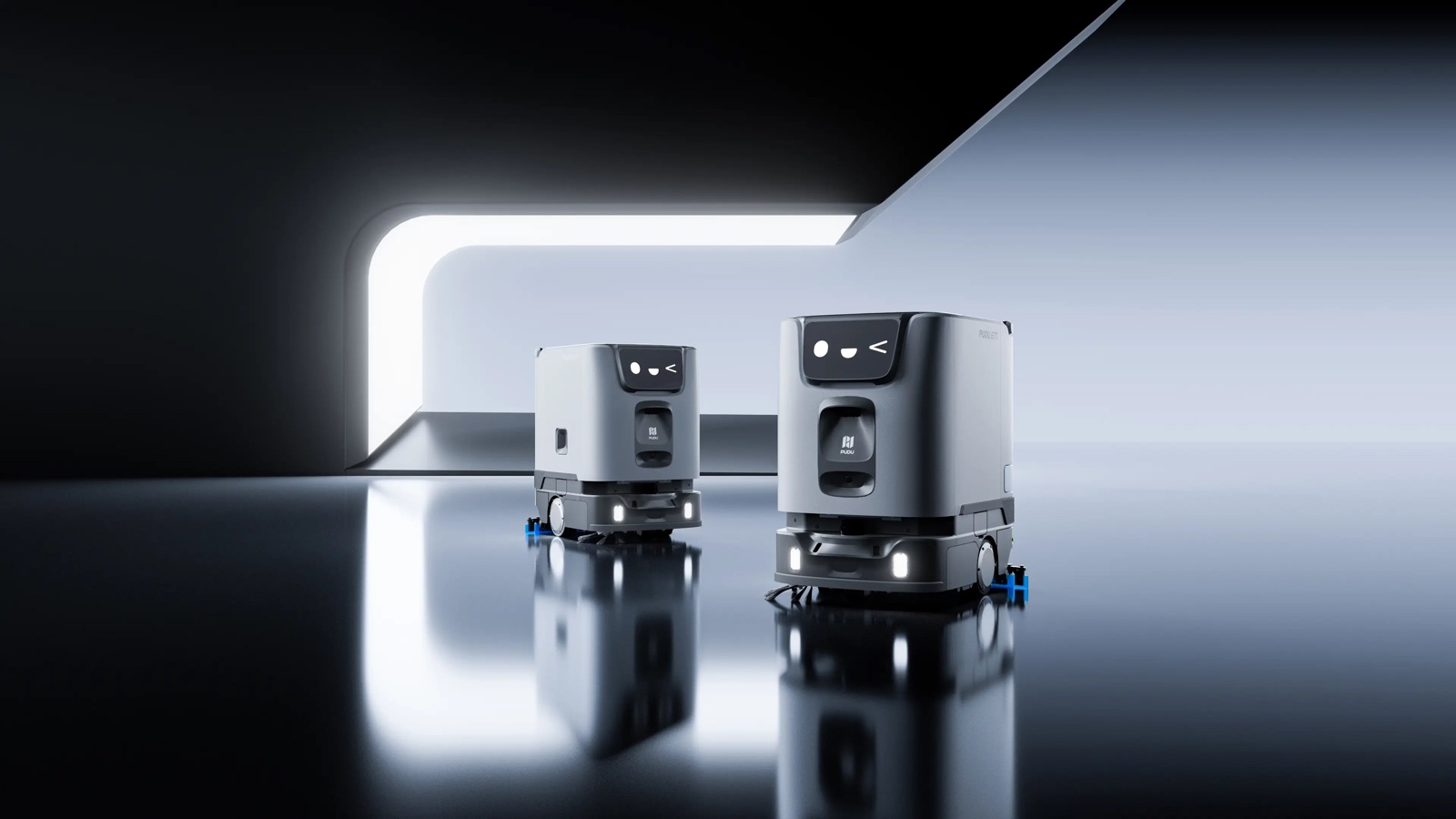
Robotic scrubber-dryers cope well with warehouses of twenty thousand square metres. Put one in a small corner shop of four hundred square metres and it gets stuck: there is no room for it between the gondolas. On 12 August 2026, Pudu unveiled the ET1, a robot 50 centimetres wide designed for exactly those spaces. The ET1 joins the range we distribute: see our page on the Pudu range from an authorised distributor.
A question of size
The ET1 is 500 mm long, 380 mm wide and 580 mm tall, and weighs roughly 45 kg. According to Pudu, half a metre of width and 60 cm of clearance are enough for it to get through. Think of the gap between gondolas in a corner shop, the back room of a pharmacy, the space beneath a low merchandising unit or the service corridor behind a restaurant.
The cleaning path is sized on the same principle: 30 cm of scrub, 39 cm of sweep and suction. Small numbers, chosen on purpose. Where the floor is crowded with furniture and fixtures, a broad machine spends its time detouring, overlapping, backing out of dead ends and leaving untreated strips. Agility earns more than width.
What hot water brings
This is what really sets the model apart, and the argument is more commercial than technical. On a restaurant floor, in a food store or at a shop entrance on a wet winter day, what you are fighting is grease, sugary spills and footprints rather than dust. The 800 rpm roller does part of the job; warmth does the rest. The water comes out of the station already warm and stays that way on board for the whole run.
Because the roller gets a constant rinse as it turns, the robot does not carry grime from the front door to the back wall, and 20 kPa of suction recovers the used water immediately. Where customers walk, fast drying is not a nicety: it is about who is responsible if someone slips.
The station does the day-to-day work
The base handles eight jobs: it charges the battery, tops up clean water, drains the dirty water, adds detergent, rinses both roller and squeegee, spins them dry and warms the water. At the end of each run it also pulls the dust out of the robot automatically, and Pudu reckons its bin needs attention roughly weekly.
In practice, this is the deciding point. If six busy shop staff have to drain and fill a robot every night, it will be sitting switched off in a corner before the month is out. Still, a self-servicing base is not a maintenance-free machine: the ET1 has parts that wear and needs regular servicing like any professional equipment. With us, that servicing is part of the rental and is done by the same technician who set the robot up for you.
What the brochure adds
The brochure Pudu has been circulating since September fills in the August presentation on four points: exactly what 4-in-1 covers, how the scrubbing works, how the robot reads its surroundings, and the practicalities of operating it.
A 4-in-1 arranged from front to back
Pudu's four functions are sweep, vacuum, scrub and dust mop. Up front, a 39 cm path is swept and vacuumed at 20 kPa; behind, an 80 mm roller spinning at up to 800 rpm bears down at 5,000 Pa across 30 cm. Loose debris is gone before the scrubbing starts, so crumbs and bits of packaging never end up churned into the recovered water.
Right after, the squeegee lifts the moisture. The brochure insists on a streak-free, walkable floor after one pass and mentions wood and marble as surfaces handled with care. In a shop that is open, that is the argument that counts: a floor left wet is a slip hazard.
A robot that reads the ground
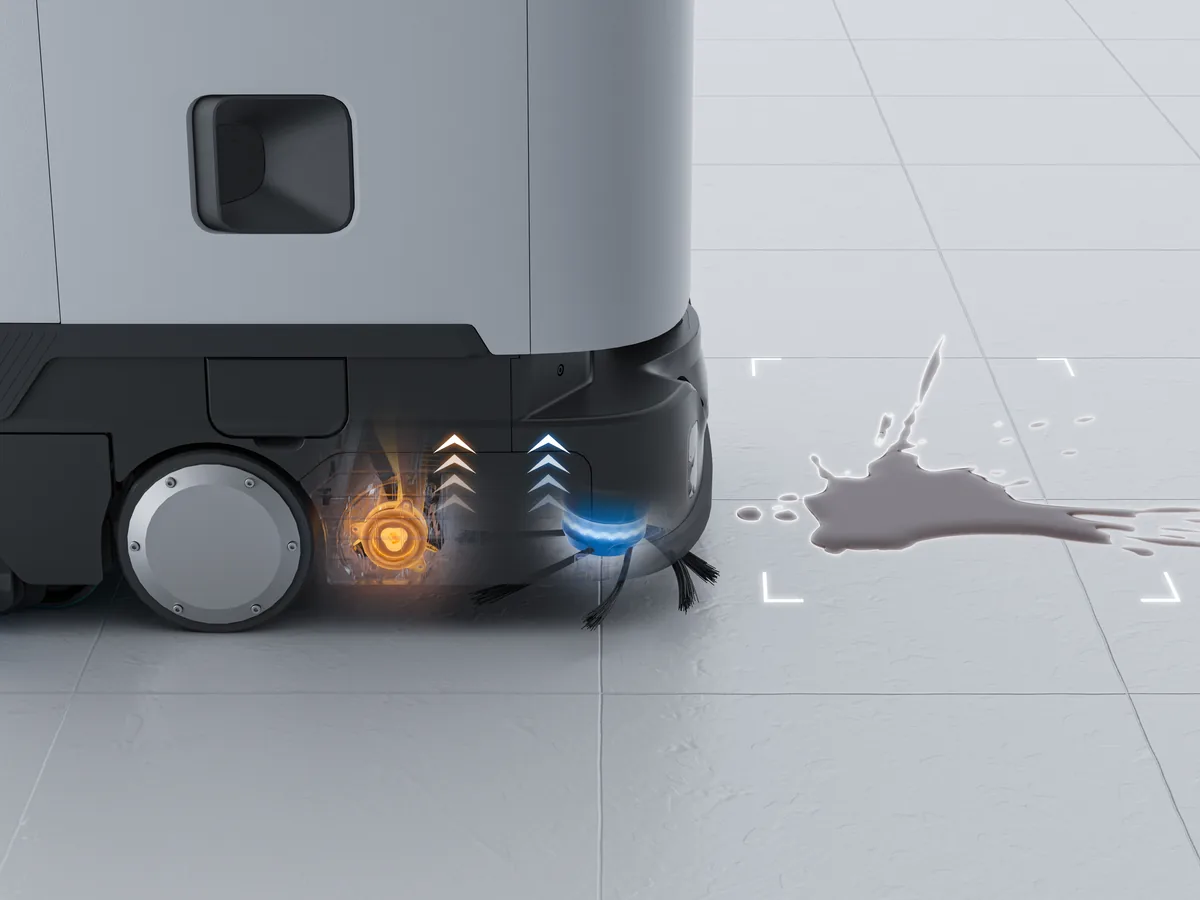
Its sensor set is a LiDAR, a 3D camera, a pair of depth cameras, cameras facing forwards and backwards, and a line laser, and the brochure describes the behaviour each situation triggers. Rug ahead: the roller goes up. Liquid on the floor: the sweeping and side brushes lift clear rather than smear it. Doormat: dry sweeping and suction only, no water. A loose cable or a packaging strap: it gives it a wide berth, while it hugs the base of a display fixture. Ingrained mark: lower speed, faster roller, more water.
Commissioning follows the same logic: no prior survey is needed, the robot builds its map while it cleans. It then produces heatmaps showing where it has been and how intensively it cleaned.
What changes for day-to-day running
The August launch left three questions open, and the brochure answers them. Sound: below 65 dB(A), quiet enough to make daytime cleaning realistic. Obstacles: steps of up to 20 mm and gaps of up to 30 mm, which covers door thresholds and the slot at a lift entrance. Floors: the robot can be linked to the lift, so a single unit can serve a multi-storey building, which is what hotels and office blocks will care about most.
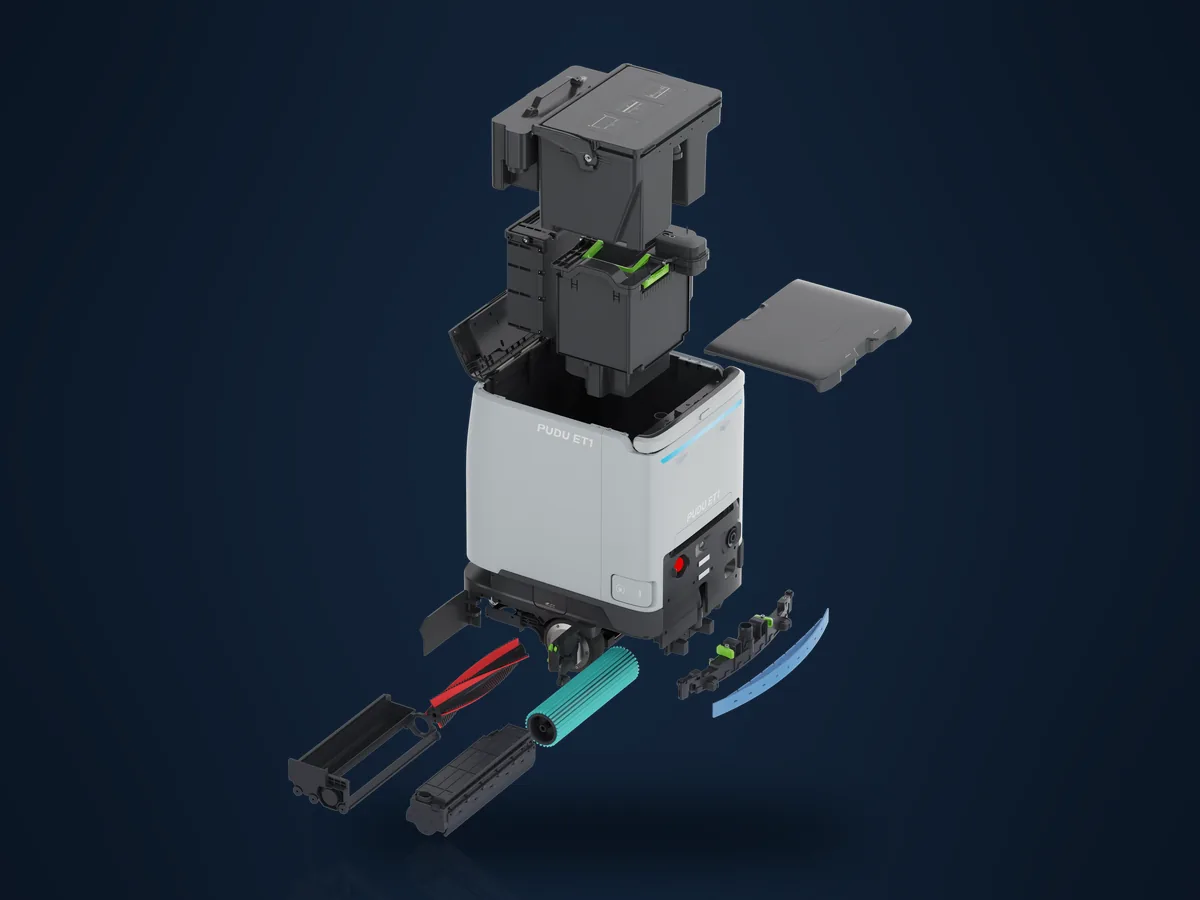
Every module that gets dirty, from the water tanks and dust box to the roller, brush, squeegee and debris tray, unclips in about half a minute for rinsing. The battery can be swapped quickly, and the robot is controlled from its 7-inch touchscreen, a mobile app or a desktop platform, with a manual mode for guiding it now and then.
Which sites it suits
Local shops and convenience stores, pharmacies, restaurants and restaurant chains, budget and business hotels, small office floors: places where cleaning is frequent, floor area modest and aisles narrow. Being small, it can also work while customers are in, which reshapes the routine: the floor no longer has to wait until the shutters are down. For a store-by-store view of which tasks go to the robot and which stay with staff, read our piece on cleaning robots for pharmacies, convenience stores and bakeries.
Within what we offer, the ET1 creates a new category rather than displacing an existing model. Tight aisles and less than 800 m²: that is its territory. Bigger premises or wide open spaces are still better served by the CC1. What settles it is how the space is actually laid out, not the square metres on the tenancy agreement.
The markets Pudu is targeting
The brochure gives a page to each of the four markets Pudu is aiming at with the ET1. It says a lot about how the manufacturer sees the machine.
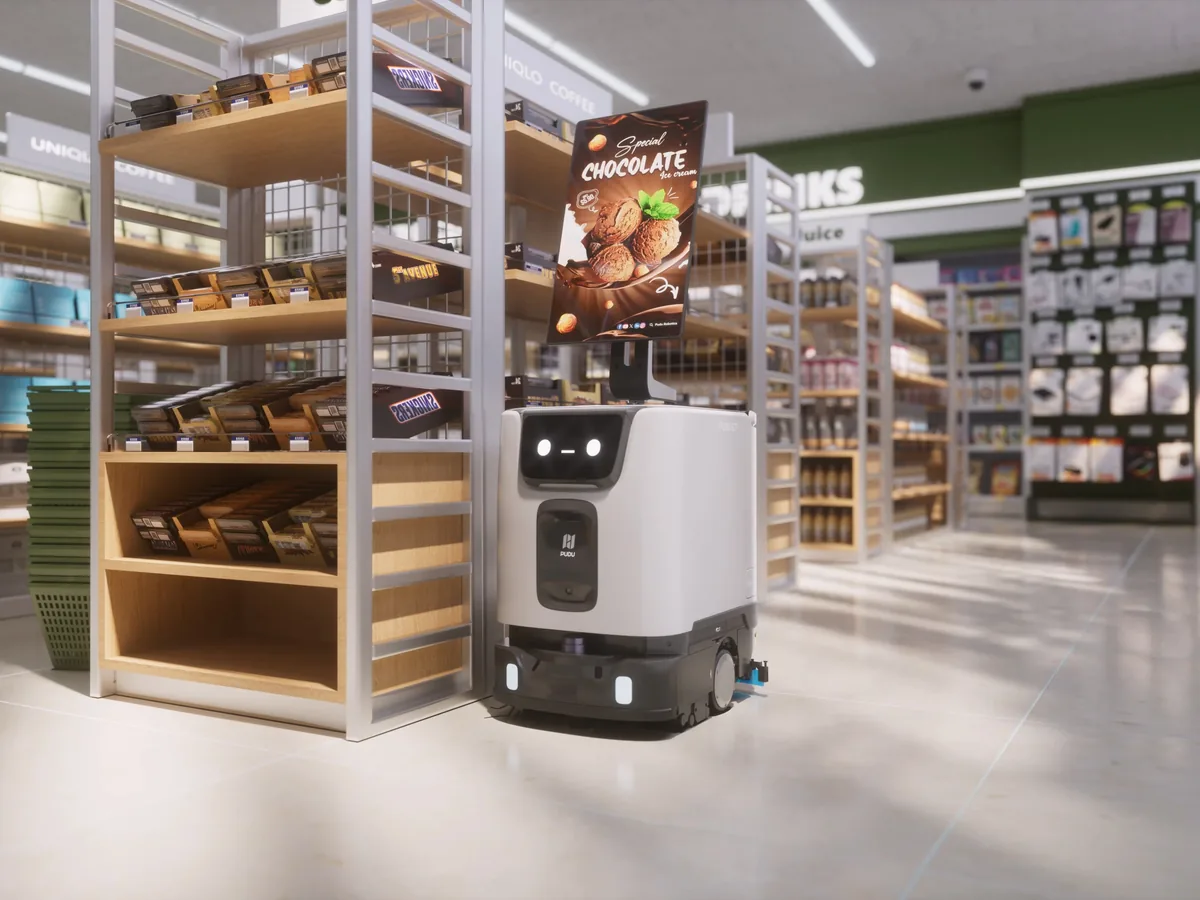
In convenience stores, drugstores and grocers, the job is frequent washing combined with in-store communication: a 50 cm passage for the aisles, powerful scrubbing and an optional 21.5-inch advertising screen. The zones named are the fresh produce section, the shelving runs, the aisles and the entrances.
For restaurants, from fast food to fine dining, the pitch is warm water to cut grease and a front sweeper that collects paper napkins, straw sleeves and leftovers. With 60 cm of clearance it gets under the tables. How it fits into the end-of-service routine alongside the staff is set out in our restaurant cleaning protocol. Kitchens are a separate case: textured anti-slip tiles need their own approach, explained in our guide to commercial kitchen floor cleaning.
In hotels, from budget to luxury, Pudu highlights vacuuming and scrubbing without changing modules, carpet edge detection and lift integration, for guest corridors, lobbies, restaurants, gyms and pool surrounds. The common areas of residential and office buildings rely on the same arguments.
Where it sits in the Pudu range
The brochure ends with a selector that places each Pudu cleaning robot by floor area and floor type. The orders of magnitude below are the manufacturer's; they describe a type of ground, not a guaranteed area.
| Model | Ground indicated by Pudu |
|---|---|
| ET1 | 100 to 800 m², moderate stains and daily carpet vacuuming |
| SH1 | small spaces such as restaurants and washrooms, walk-behind machine |
| CC1 | 500 to 1,500 m² for scrubbing, up to 2,000 m² of carpet |
| CC1 Pro | 500 to 2,500 m², stubborn stains |
| BG1 | 2,500 to more than 10,000 m², stubborn stains |
| BG1 Pro | large areas such as car parks, heavy-duty scrubbing |
| MT1 Vac | 500 to 15,000 m² of carpet or hard floors, vacuuming |
| MT1 and MT1 Max | 500 to 20,000 m² of sweeping, car parks and complex sites |
The ET1 therefore sits at the bottom of the range in terms of floor area, but not in terms of equipment: it is the only one that heats its water and lets you set the temperature. Between 500 and 800 m², it overlaps with the CC1, and the layout decides. Narrow aisles, tables and greasy zones point to the ET1; an open floor plate or a growing area points to the CC1.
On the manufacturer's own figures, citing a 2025 Frost & Sullivan study, Pudu ranks first worldwide for professional service robots by revenue, holds 29% of the professional cleaning robot segment, has shipped over 130,000 units and sells in over 85 countries.
What we do not know yet
The brochure has filled some of the gaps from August: noise level, lift compatibility, obstacle crossing. Four things are still missing: the steepest slope it can climb, its IP rating, its behaviour at automatic doors and how long the consumables really last. We will fill them in once Pudu publishes them instead of guessing.
Two numbers need careful reading. The output of 300 to 720 m²/h is a best case: a crowded floor full of turns will come in lower. The 100 to 800 m² bracket describes the kind of premises the ET1 is built for; it is not a promise of what it will clean at your site in a single night. That is something we measure at the demonstration, on your own floor.
Frequently asked questions
What is the Pudu ET1?
The opening model of Pudu Robotics' new E Series, presented on 12 August 2026: a small self-driving scrubber-dryer that sweeps, vacuums, scrubs and dust mops in one go, intended for business premises between 100 and 800 m².
How is it different from the CC1?
Mainly its dimensions. Needing only a 50 cm gap and 60 cm of height, the ET1 reaches aisles the CC1 is too big for. It adds warm-water washing and an eight-function base. Once you go past 800 m², the CC1 is usually the better choice.
Why does hot water make a difference?
Restaurant and food retail floors carry fat and sticky spills, which scrubbing action on its own struggles with. Warm water from the base, held at temperature during the run, loosens them.
What does the station do?
Eight things: charging, filling with clean water, draining waste water, dosing detergent, rinsing the roller, rinsing the squeegee, spin-drying and heating the water. Without it, a robot would soon be neglected in a shop where staff have no spare minutes.
Is the ET1 available yet?
Pudu launched it on 12 August 2026 and is building up its European presence. We are an authorised Pudu distributor and confirm stock and demonstration dates site by site; pricing for your premises follows the demonstration.
Can the ET1 use the lift?
Yes, according to Pudu: the ET1 can summon the lift and move between storeys. Whether your installation supports it depends on the lift model and its control interface, which we confirm with your lift engineer before installation.
Is the ET1 noisy?
Pudu quotes less than 65 dB(A). Being only 38 cm wide, it slips past shoppers and can clean while you trade, with cleaning times fixed around your real footfall.
A question about your own site?
Write to us and we will reply within one working day. If you want to go further, the demonstration takes place on your own floors, free of charge.