
Autonomous commercial lawn mower: what it changes on corporate and public grounds
30 September 2026 · By Gautier F. · 10 min read
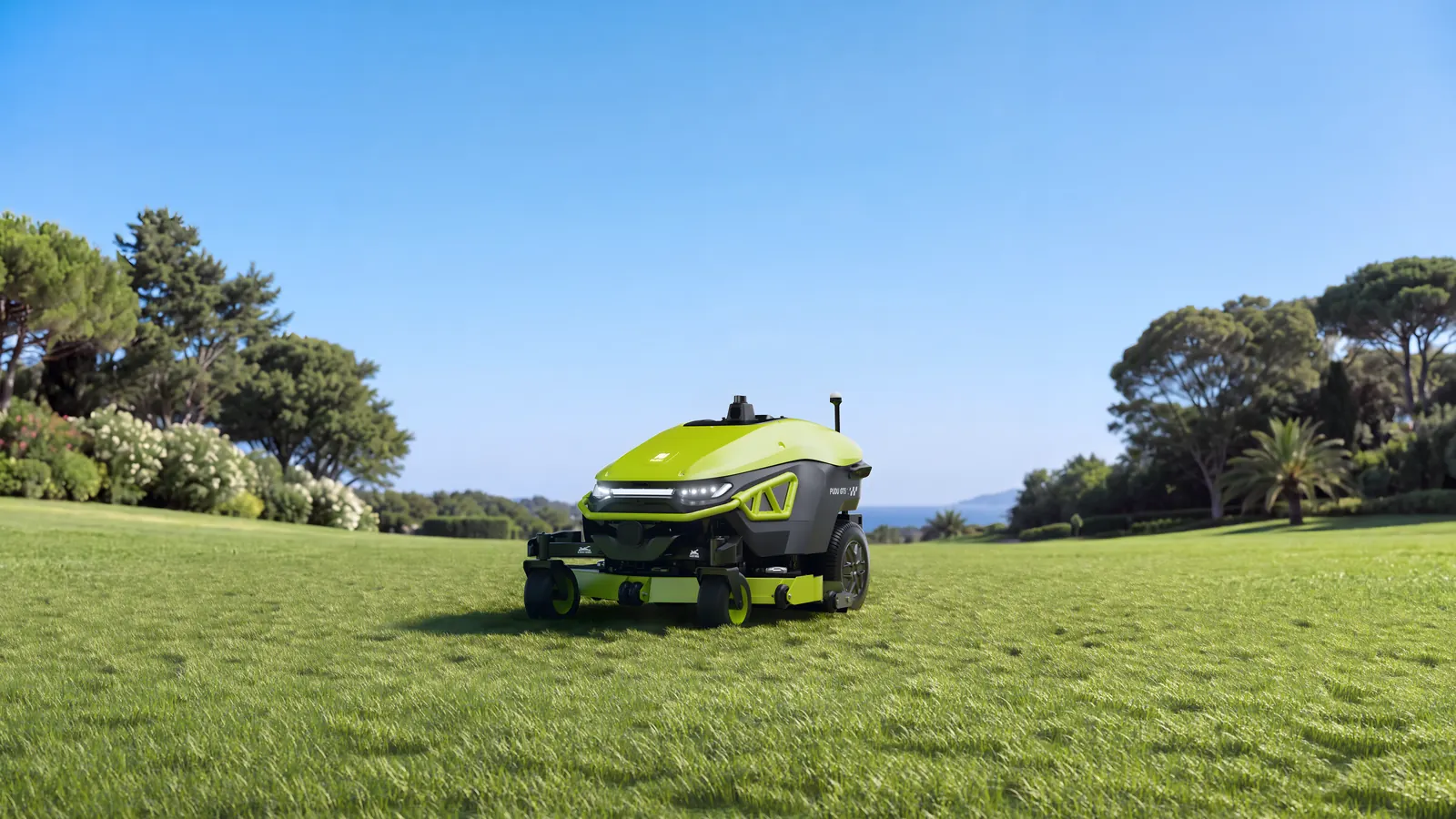
The robotic mowers most people know circle a garden inside a buried wire. The commercial generation is a different machine: several hundred kilograms, a cutting width close to a ride-on mower, satellite positioning to within a few centimetres and a hopper that it empties on its own. This guide explains how an autonomous commercial lawn mower works, which grounds suit it, what stays with the grounds team, and what sets the price of a quote, using the three models of the PUDU GT range as reference points.
How an autonomous commercial lawn mower differs from a garden robot
Three things separate a commercial autonomous mower from the consumer robots sold for gardens. The first is scale: cutting widths from about 90 cm to 1.60 m, working rates stated in thousands of square metres per hour, and areas per charge counted in hectares. The second is navigation: instead of a boundary wire, the machine combines satellite positioning corrected by RTK, LiDAR and cameras, so zones are drawn on a digital map and changed without digging. The third is collection: the larger machines vacuum clippings and leaves into a hopper and drive to a dump point to empty it, rather than mulching everything back into the lawn.
Against a ride-on mower, the comparison is about labour and timing rather than cut quality. A ride-on needs a driver for every hour of mowing; an autonomous machine needs someone to plan, check and finish. That shifts grounds staff from driving towards edging, planting, pruning and inspection, which are the tasks that make grounds look cared for.
The PUDU GT range at a glance
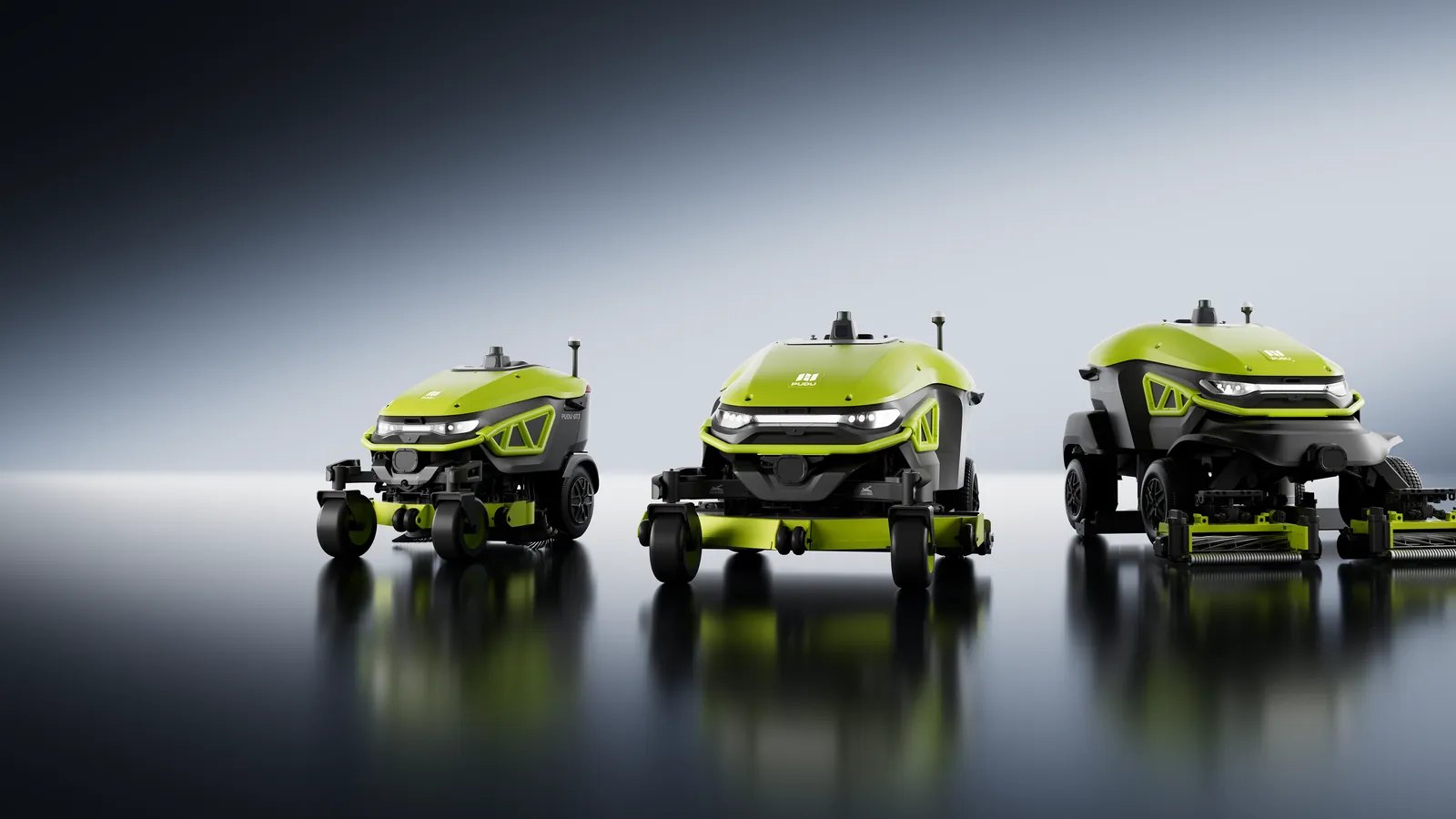
Pudu Robotics announced its first commercial mowers, the GT range, on 1 September 2026 and showed them at GaLaBau in Nuremberg about two weeks later. The three models share the same navigation and safety principles but target different grounds. Figures below come from the manufacturer's brochures as published on our PUDU GT range page.
| Model | Cut and width | Cutting heights | Collection | Coverage per charge | Steepest mowing slope | Mass |
|---|---|---|---|---|---|---|
| GT3, zoned corporate grounds | Three-blade rotary deck, 91 cm | From 3.8 up to 11.4 cm | 60 litre bin | Up to 2 hectares | 15 degrees | About 450 kg |
| GT5, big open lawns | Three-blade rotary deck, 1.52 m | From 3.8 up to 15.2 cm | 100 litre bin | Up to 6.5 hectares | 20 degrees | About 850 kg |
| GT7, fine turf | Three floating reels, about 1.57 m (62 in) | From 0.5 up to 5 cm | 130 litre bin, or a no-collection mode | Up to 7 hectares without collecting | 30 degrees | About 950 kg |
Each carries an IP66 rating, so rain and dust are not a reason to park it, and all three are managed through the manufacturer's app and fleet platform, which shows location, progress and alerts. Stated areas per charge are maximum values: splitting the ground into many small zones, transit between them and collection all reduce what one charge achieves.
Which grounds suit which model
Zoned corporate sites
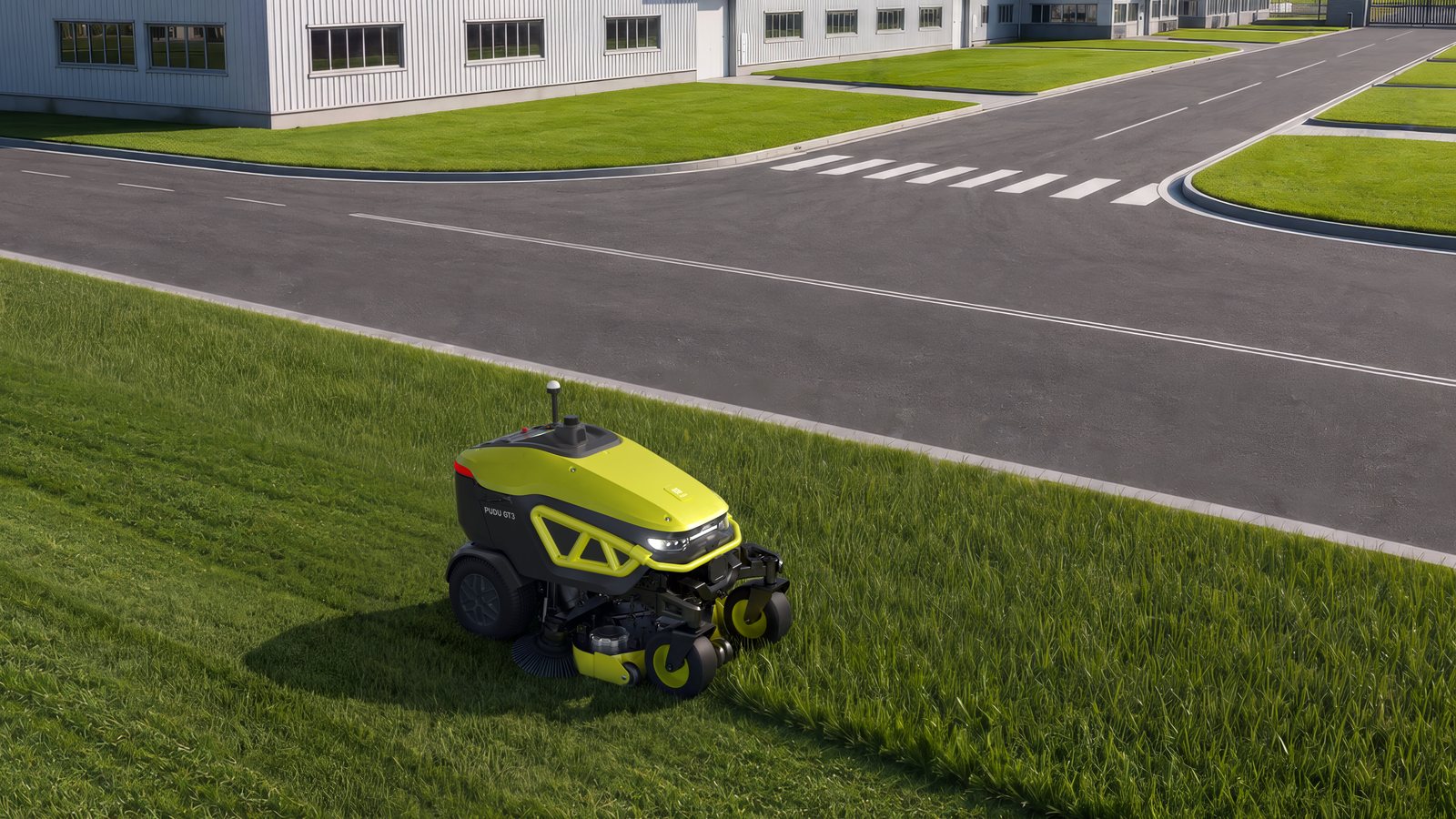
A logistics platform or a factory rarely has one big lawn. It has strips between car parks, banks along internal roads, verges by the gatehouse. The PUDU GT3 is designed for this: narrow enough to pass gates and pathways, it links zones along set routes and, with its blades off, sweeps paths and pavements once the growing season winds down, which keeps it working through autumn.
Large open lawns
Municipal parks, school and university grounds, cemeteries and airport verges reward width. The PUDU GT5 cuts 1.52 m per pass and carries enough battery for most of a working day. On this model the mowing areas may be traced over an aerial satellite view, sparing someone a long perimeter walk on very large sites.
Fine turf
Golf fairways, approaches and sports pitches need a reel cut, low heights and even striping. The PUDU GT7 uses three floating reel units, four-wheel drive for slopes up to 30° and programmable stripe patterns, and can run with its suction off for near-silent early-morning work.
What decides feasibility on your site
Hectares are what most site managers quote first, but four other factors usually decide whether an autonomous mower will work well.
- Slopes and banks. Each model has a maximum slope for mowing. Steeper ground is simply left off the digital map for people to handle, so a site with many steep banks keeps a larger share of hand work.
- Satellite reception. Centimetre-level RTK positioning relies on seeing enough satellites overhead. Dense tree cover or tall buildings close to the lawn can degrade path holding, which is checked on site.
- Access and ground bearing. At 450 to 950 kg, the machine needs gates wide enough, firm transit routes and a plan for waterlogged ground after heavy rain.
- Dump point and charging. Clippings must be emptied somewhere sensible, and the charging spot needs power (3.3 kW standard, 6 kW for the fast-charge option) close to the routes.
Public access adds a safety layer. The GT machines detect pedestrians, vehicles and obstacles and slow down, go around or stop depending on the risk, and a remote emergency stop is available. Scheduling mowing outside the busiest hours remains sensible on school grounds and in parks.
Fixtures hidden in the grass
Pop-up sprinkler heads, drainage grates, lighting bollards, cable pits and memorial plaques are easy to forget on a plan and costly to hit. During mapping, each one is either marked as an obstacle or surrounded by a small forbidden area, and the first mowing runs are watched until the grounds team is confident the map is complete. Temporary items, such as event marquees or goalposts moved for a tournament, are handled by editing the zone for the day rather than redrawing the whole site.
What stays with the grounds team
An autonomous mower covers surfaces; it does not garden. Planted beds, the ground around trunks, hedges, strips along walls, areas beyond the slope limit and quality checks stay with people. The practical gain is that staff no longer spend long hours on a ride-on across open lawns, and can give that time to visible finishing work. The same logic underpins our cobotic approach to floors: robots handle the repetitive coverage while people keep the judgement calls and the detail.
Seasonality matters too. Mowing peaks in spring and early summer and fades in late autumn. A machine that can switch to leaf collection or path sweeping, as the GT3 does, stays useful for more months of the year, which weighs in the cost per month of use.
Pudu GT3 price: what the quote depends on
There is no public catalogue figure for the GT3 or its siblings on this site, because the figure that matters is the cost of maintaining your grounds, and that depends on far more than the machine. Here is what moves a quote up or down.
- Model and options. GT3, GT5 or GT7, and whether fast charging is added.
- Number of machines. Set by actual mowable area per zone, target cutting frequency and the time available each day.
- Site layout. Many small zones and long transit routes need more set-up time and reduce area per charge.
- Infrastructure. Charging spot, power supply and dump point, and any work needed to create them.
- Commissioning. Mapping, zone drawing, no-go zones, schedules and training for the team.
- Maintenance and wear. Blades, filters, brushes, servicing and software updates over the term.
- Contract type. An all-inclusive monthly fee or a purchase with a maintenance contract, and the length of the term.
To compare a robotic option fairly, set it against the full current cost of mowing: staff hours or contractor visits, fuel, machine servicing, and clippings disposal. Our comparison of rental and purchase explains how the two routes differ in ownership and risk; if your finance team is considering third-party finance, our note on cleaning robot leasing applies equally to mowers.
From site survey to routine mowing
The rollout follows four steps. A survey and demonstration on your grounds checks slopes, access, satellite reception and the likely number of zones, while the robot cuts a test area under your eyes. Mapping comes next, by an exploration lap or, on the GT5, from satellite imagery, after which mowing areas, transit paths and forbidden areas are marked. Settings are then fixed: height of cut per zone, frequency, schedules, dump point. Finally the team learns the app, and routine mowing begins, with alerts and progress visible remotely through the same kind of fleet platform used for floor robots.
Adding grounds to the same contract
Many of the sites whose floors we clean, distribution centres, factories, campuses and public buildings, also have lawns and paths to look after. Being an authorised Pudu distributor, we can supply the three GT mowers under the two formulas used for our floor robots, with one person handling survey, set-up, training and upkeep; availability dates are given with each quote. Describe your grounds, their approximate area and the slopes you know of, and we will arrange a demonstration and a quote.
Sources and references
Regulations, public bodies and manufacturer documents this article draws on. Links open in a new tab.
- Pudu Robotics Launches PUDU GT Series, a Three-Model Lineup of Commercial Robotic Mowers (Pudu Robotics (press release via PR Newswire)) : Manufacturer launch release for the GT3, GT5 and GT7: target grounds, RTK accuracy, cutting widths, slope capability and IP66 rating.
- Pudu Robotics Showcases PUDU GT Series and Intelligent Grounds Care Solutions at GaLaBau 2026 (Pudu Robotics (press release via PR Newswire)) : Manufacturer release on the first public showing of the GT range at GaLaBau in Nuremberg, 15 to 18 September 2026.
- RTK Fundamentals (European Space Agency (Navipedia)) : Explains how RTK works: base station, real-time corrections, ambiguity resolution and why a fixed solution gives centimetre accuracy.
- IEC 60529:1989+A1:1999+A2:2013 Degrees of protection provided by enclosures (IP Code) (IEC) : Official page of the standard that defines IP codes, the reference behind the IP66 rating quoted for the mowers.
Frequently asked questions
Does an autonomous commercial mower need a boundary wire?
No. The PUDU GT machines locate themselves with RTK satellite positioning to about 2.5 cm, backed by LiDAR and cameras. Zones, routes and no-go areas are drawn on a digital map and can be changed without any groundwork. Tall buildings or heavy canopy near the lawn can weaken that accuracy, so reception is tested during the survey.
How much does a Pudu GT3 cost?
The price is given on quote after a survey of your grounds, because it depends on the number of machines, the layout, the charging set-up and whether you choose an all-inclusive monthly fee or a purchase with maintenance. The demonstration also shows how much area one machine really covers on your site.
Can an autonomous mower work where the public walks?
Yes, with sensible scheduling. The GT machines recognise people, vehicles and obstacles, and slow down, go around or stop depending on the risk. A remote emergency stop is available. On school grounds, parks and campuses, mowing is usually planned outside the busiest hours.
What happens to the grass clippings?
The machine vacuums clippings and leaves into its hopper, 60 L on the GT3, 100 L on the GT5 and 130 L on the GT7. Once the bin fills, the robot travels to its designated emptying spot, tips the load and returns to finish the pass it interrupted. The GT7 also offers a mode that leaves clippings on the turf.
Will it replace our grounds contractor?
It takes over the open mowing, not the whole job. Edges, beds, hedges, steep banks and seasonal work still need people, whether in-house or contracted. Many sites keep their contractor for those tasks and reduce the number of mowing visits.

A question about your own site?
Write to us and we will reply within one working day. If you want to go further, the demonstration takes place on your own floors, free of charge.