
Tennant T16AMR · specs, operator review and alternatives (2026)
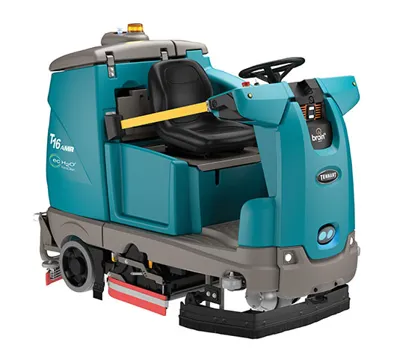
The Tennant T16AMR is a heavy-duty industrial autonomous floor scrubber, launched in 2021 on the base of the T16 ride-on, for warehouses, logistics and manufacturing sites. The largest machine in Tennant's AMR range: 910 mm cleaning width, 190 L of clean water, cylindrical brushes with a debris hopper, up to 5,890 m²/h in manual driving. It weighs up to 785 kg and needs aisles of at least 1,450 mm. Price and availability on request.
At a glance
Technical data
Fit by environment
Floors and soiling
An industrial scrubber with cylindrical brushes: its core target is heavily soiled industrial hard floors, with partial debris pick-up thanks to the hopper, where a disc head only scrubs. No carpet. Bulky waste still has to be dealt with beforehand despite the hopper. This is the machine for deep scrubbing in warehouses and manufacturing sites.
What the manufacturer does not say
The hopper changes the scope. The cylindrical brushes and the hopper pick up part of the debris while scrubbing: on an industrial floor, this reduces the preliminary sweeping pass that disc heads require. It is the central technical argument, and it is rarely stated clearly.
Two battery chemistries, two runtimes. Lithium (12.2 kWh, 5.5 h) or lead-acid (4 h): the energy capacity of the lead-acid version is not published. To be clarified at quotation stage.
No published customer reference for this model. Cost structure: machine + consumables (cylindrical brushes) + manual water handling.
Buying or contracting out
If you buy (capex), the built-in hopper reduces the preliminary sweeping pass on industrial floors, but the choice of battery chemistry commits you on runtime (lead-acid 4 h, lithium 5.5 h) and on the energy budget. Under a full-service contract (opex), the contractor decides this configuration and carries the continuity commitment. See the Pudu range and the on-site demonstration, or our robotic cleaning service.
Strengths and limitations
Strengths
- The highest capacity in the AMR range (190 L, 910 mm).
- Cylindrical brushes + hopper: picks up part of the debris while scrubbing.
- Established Tennant dealer and after-sales network.
Limitations
- Up to 785 kg and 1,450 mm passage width: very large, unobstructed sites only.
- No docking station: manual water handling.
- Public-area certification not documented.
Alternatives
- In the Tennant range: the T7AMR (110 L) and the X6 ROVR (95 L, with dock), one size down.
- Against other large autonomous scrubbers: the Kärcher KIRA B 200 and the Gausium Scrubber 75.
For a comparison with the Pudu BG1 Pro, see the Pudu BG1 Pro profile. To put figures on it: request a quotation, weigh up rental against purchase, or book an on-site demonstration.
Sources
Consulted on 16/07/2026: Tennant product page for the T16AMR; internal robot database (v39). Values marked "n/p" are not published by the manufacturer. No price is published: available on request.
Frequently asked questions
What sets the T16AMR apart?
Which sites is it aimed at?
Does it fit through narrow aisles?
What does it cost?
Interested in the Tennant T16AMR, or in an alternative?
Ask us: we will tell you plainly whether this model suits your floors, and what we would do in your position. Reply within one working day.